
Supercharge Your Marketing: 5 Essential Lead Gen Tools
5 Best Lead Generation Tools for 2025 to Revolutionize Your Marketing Strategy

Lead generation tools are the software and systems that capture, qualify, and route potential customers into your sales funnel, and 2025 is a pivotal year because advances in AI, automation tools, and privacy-first data strategies make these platforms dramatically more effective. This article will show you how modern lead gen tools — from landing page builders and website visitor tracking to AI lead scoring and marketing automation software — work together to increase lead volume, improve lead quality, and reduce cost per acquisition. You will learn what features to prioritize, which tool archetypes map to specific business needs, and how to design integrations that turn fragmented data into actionable signals for sales teams. Along the way we'll provide concrete checklists, integration pairings, and comparison tables to help you evaluate options and run a pilot that proves ROI. First we define the category and its core functions, then we evaluate five transformative tool archetypes and present selection criteria and integration playbooks you can implement immediately. By focusing on CRM integration, conversion rate optimization, and AI-driven personalization, this guide equips marketing and sales leaders to modernize workflows and measure lift across the funnel.
What Are Lead Generation Tools and Why Are They Essential for Your Marketing Strategy?
Lead generation tools are software solutions that collect contactable prospects, enrich their profiles, and drive them through acquisition and nurturing workflows using automation, analytics, and integration with sales systems. They work by capturing intent signals (like page visits and form submissions), enriching that raw data with firmographic and behavioral attributes, and applying scoring or routing rules so sales can act quickly and with context. The specific benefit is faster lead response, improved qualification, and higher conversion rates through consistent follow-up and personalization. Modern marketing teams rely on these platforms to scale outreach while preserving relevance, turning anonymous website visitors into trackable contacts for email outreach automation and sales tools. Understanding these core functions clarifies why investments in landing page builders, lead enrichment, and CRM integration are central to sustainable growth and measurable ROI.
How Do Lead Generation Tools Improve Customer Acquisition and Conversion Rates?
Lead generation tools improve acquisition and conversion by automating repetitive tasks, surfacing high-intent prospects, and enabling personalized outreach at scale through data-driven segmentation and triggers. Automation tools reduce latency between capture and first contact, which research and practitioner experience link to higher conversion rates and lower lead decay. Personalization driven by enrichment data — job title, company size, behavior — increases relevance in email outreach automation and nurtures, improving open and click-through rates that lead to better pipeline conversion. For example, routing MQLs to sales within an hour and prioritizing those with high predictive lead scores often produces measurable uplift in lead-to-opportunity conversion and shortened sales cycles. This operational improvement naturally leads into evaluating the specific features that make a lead generation platform effective.
Artificial Intelligence in Digital Marketing Automation: Improving Efficiency and Engagement
The integration of Artificial Intelligence (AI) into marketing strategies is crucial in the current era of digital transformation, particularly in automation, personalization, and forecasting. This research examines the evolving role of AI in the transition from traditional marketing frameworks to data-driven methodologies, thereby enhancing marketing efficiency and customer engagement. The growing dependence on AI for strategic marketing decision-making highlights the importance of this study. Utilizing a systematic literature review and thematic analysis, this research synthesizes data from numerous studies to comprehensively understand the impact of AI on marketing. The findings indicate that AI significantly streamlines marketing operations.
What Key Features Define Effective Lead Generation Software?
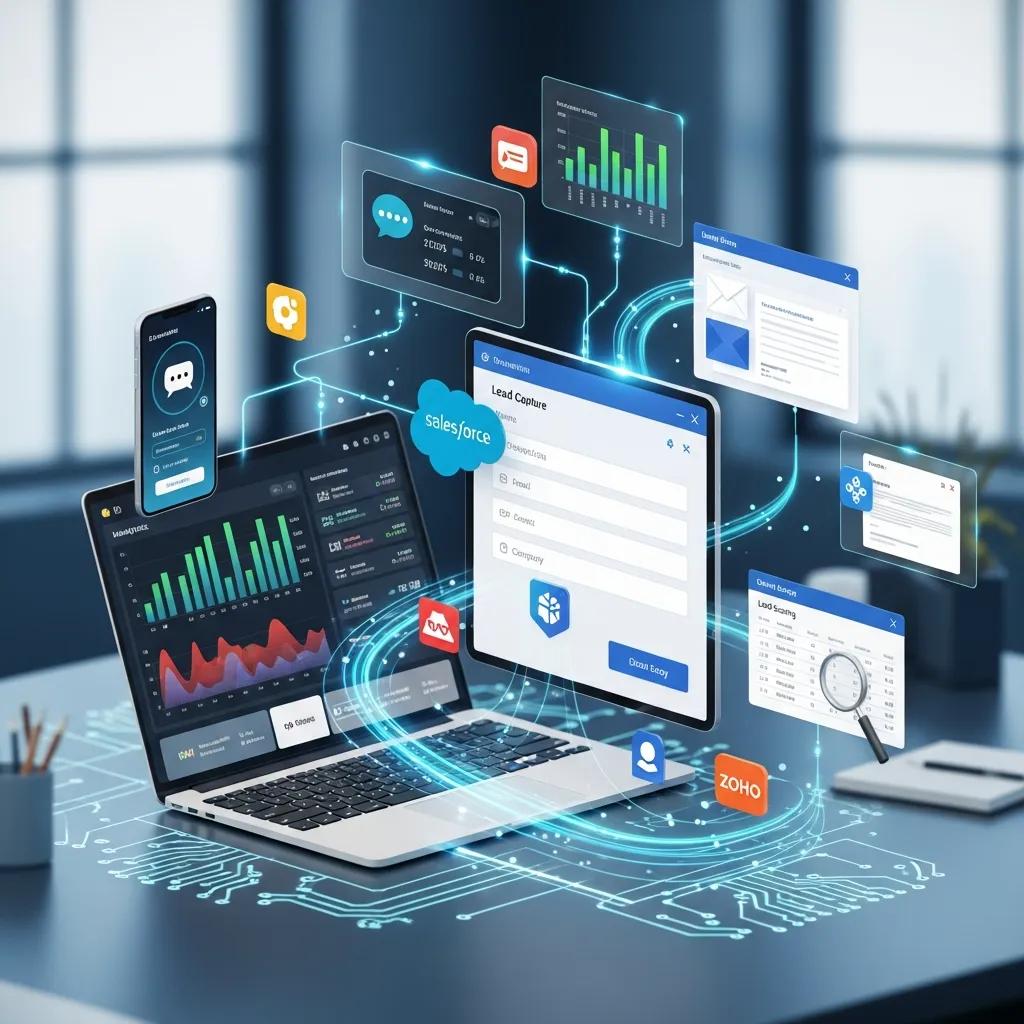
Effective lead generation software combines a set of core features: dependable lead capture forms and landing page builders, website visitor tracking, enrichment connectors, lead scoring or predictive analytics, and bi-directional CRM integration. Each feature serves a role: capture forms collect explicit data, tracking captures behavioral signals, enrichment fills gaps for segmentation, scoring prioritizes follow-up, and CRM sync ensures a single source of truth. When assessing maturity, prefer native CRM sync over fragile one-way exports, field-level mapping instead of generic imports, and built-in compliance tools for consent and data retention. Security and privacy features — like consent capture and configurable retention — matter as much as conversion-boosting widgets because compliant data yields long-term usable signals for AI lead scoring and personalization. A short checklist of maturity indicators helps teams compare platforms quickly.
- Native CRM sync: Ensures reliable, near-real-time data flow and reduces duplication.
- Field-level mapping: Preserves context for lead attributes and custom scoring.
- Consent & privacy controls: Maintains compliance and preserves first-party data quality.
This feature-level clarity sets the stage for comparing specific tool archetypes that dominate modern lead-generation stacks.
Which 5 Lead Generation Tools Will Transform Your Marketing in 2025?
In 2025, five lead generation tool archetypes will deliver the biggest impact: prospecting and visitor identification platforms, email nurturing and automation tools, analytics-driven lead scoring systems, conversion-focused landing page builders and form optimizers, and AI-first automation platforms that unify personalization and workflow orchestration. Each archetype addresses a distinct funnel stage and, when combined, drives measurable improvements in lead velocity and conversion rate optimization. Below is a ranked list of the five archetypes, followed by an EAV comparison to help you match capability to business need.
- Prospecting & Visitor Identification Tools — Identify anonymous visitors and build prospect lists for targeted outreach.
- Email Nurturing & Marketing Automation Tools — Automate drip sequences and behavior-triggered campaigns to convert MQLs.
- Analytics-Driven Lead Scoring Platforms — Use data signals and predictive models to prioritize the highest-value leads.
- Landing Page Builders & Form Optimizers — Increase conversion rates with fast, testable pages and progressive profiling.
- AI-First Automation & Orchestration Platforms — Personalize outreach and automate multi-step workflows across systems.
Below is a concise comparison of these five archetypes to clarify their primary features and business benefits.
| Tool Archetype | Key Feature | Business Benefit |
|---|---|---|
| Prospecting & Visitor ID | Website visitor tracking + enrichment | Faster top-of-funnel list building and outreach targeting |
| Email Nurturing & Automation | Behavior-triggered drip campaigns | Scaled personalized nurture and improved MQL→SQL conversion |
| Analytics-Driven Scoring | Predictive scoring models | Higher lead qualification accuracy and efficient sales time use |
| Landing Page Builders | A/B testing + progressive profiling | Higher conversion rates and improved form completion |
| AI-First Orchestration | Automated personalization workflows | Personalized outreach at scale and reduced manual routing |
This comparison makes it easier to map a tool archetype to a tactical need — from prospecting to scoring — which leads into detailed use-case descriptions for each archetype.
How Does Tool 1 Enhance Prospecting and Lead Capture?
Prospecting and visitor identification tools enhance lead capture by converting anonymous web traffic into enriched prospects using IP intelligence, cookie signals, and third-party enrichment to append firmographic and contact data. The mechanism is straightforward: track behavioral signals (page depth, product views), match to business records, and surface a prioritized outreach list for SDRs or marketing campaigns.
The business benefit is reduced list-building time and higher quality outbound matches, enabling targeted email outreach automation and more efficient cold outreach.
Typical workflows include daily syncs to CRM, segmentation by intent score, and automated campaign enrollment based on viewed product pages.
Ensuring reliable API integration and field mapping reduces manual cleanup and lets sales act on fresh, prioritized leads.
How Does Tool 2 Automate Lead Nurturing and Email Marketing?
Email nurturing and marketing automation tools create sequenced touchpoints that react to behavior and profile attributes, enabling timely, personalized communication without manual effort.
These tools use triggers — downloads, page visits, inactivity — to send tailored messages, test subject lines, and optimize timing through A/B testing, improving open and click rates.
Key metrics to monitor are open rate, click-through rate, and conversion rate per sequence, which together indicate nurture health and content relevance.
Integration with CRM and analytics platforms allows closed-loop reporting, tying nurture performance to pipeline outcomes and conversion rate optimization efforts.
A sample sequence might move a contact from educational content to demo booking using progressively specific CTAs and dynamic content based on scoring signals.
How Does Tool 3 Use Data Analytics to Optimize Lead Scoring?
Analytics-driven lead scoring platforms combine behavioral signals, demographic and firmographic attributes, and historical conversion patterns to generate prioritized lead scores, often enhanced by machine learning to surface non-obvious high-value prospects.
The mechanism is to weight signals (e.g., product page views, job title) and iteratively train a predictive model on past conversion outcomes so scoring improves over time.
Typical signals include website visit frequency, content downloads, company size, and engagement recency; predictive models help allocate sales follow-up to leads with the best closing probability.
Validation requires A/B testing and monitoring model drift; teams should chart score buckets against conversion rates and adjust signal weights when performance deviates. Well-governed scoring reduces time-to-contact and increases sales efficiency.
AI-Driven Lead Scoring: Leveraging Random Forest and Logistic Regression for Enhanced Sales Efficiency
This research paper investigates the application of advanced machine learning methodologies, specifically Random Forest and Logistic Regression, to augment sales efficiency via AI-powered lead scoring and qualification. The study addresses the prevalent challenge encountered by sales teams in lead prioritization and conversion rate optimization by employing predictive algorithms to identify high-potential prospects. Through a rigorous analysis of historical sales data, the paper substantiates the superior accuracy and reliability of Random Forest and Logistic Regression models when contrasted with conventional heuristic approaches.
How Does Tool 4 Increase Conversion Rates with Landing Pages and Forms?
Landing page builders and form optimizers increase conversions by simplifying user journeys and testing design, messaging, and form length to reduce friction and improve completion rates.
Techniques such as progressive profiling, dynamic content, social proof, and concise CTAs increase perceived relevance and trust, while A/B testing identifies the highest-performing variants.
Integration with analytics and CRM ensures each submission is enriched and routed appropriately, supporting accurate attribution and conversion rate optimization.
Typical optimizations include removing extra fields, adding a short testimonial, and offering a contextual content asset, which together often lift form completion by measurable percentages. These improvements are most effective when paired with targeted traffic and clear post-submit workflows.
How Does Tool 5 Leverage AI for Smarter Lead Generation and Workflow Automation?
AI-first automation platforms combine natural language personalization, predictive lists, and automated multi-step workflows to deliver contextual outreach and streamline lead routing, enabling scale without sacrificing relevance.
AI capabilities can draft personalized email copy, rank prospects by conversion likelihood, and trigger follow-up actions across CRM and email systems, reducing manual orchestration.
Practical use-cases include generating tailored outreach sequences for top-tier accounts, creating lead summaries for SDRs, and routing cold-to-warm transitions automatically based on combined engagement and score thresholds.
Caveats include data quality dependencies and governance needs — poor enrichment or biased training data leads to mis-prioritization, so teams must monitor metrics like conversion by cohort and model drift. Proper governance and monitoring ensure AI augments human judgment rather than replacing it.
Intro: The following table helps readers quickly scan core differentiators among the five archetypes to choose a fit for prospecting, nurturing, scoring, landing pages, or AI automation.
| Tool | Feature Focus | Best For |
|---|---|---|
| Visitor ID | Enrichment + intent signals | Prospecting and account-based outreach |
| Automation | Behavior-triggered campaigns | Lead nurturing at scale |
| Scoring | Predictive analytics | Prioritizing sales outreach |
| Landing Pages | CRO and progressive capture | Campaign-specific conversions |
| AI Orchestration | Personalization + workflows | High-volume, high-personalization programs |
How to Choose the Right Lead Generation Software for Your Business Needs?
Selecting lead generation software requires balancing budget, scale, integration needs, analytics capability, and compliance features so your stack delivers measurable improvements without creating data silos. Begin by defining desired outcomes (more SQLs, faster response, lower CPL) and identifying the minimal feature set that maps to those outcomes — for example, CRM integration and lead scoring for sales-driven organizations or landing page builders and A/B testing for campaign-led acquisition. Run a short pilot with clear KPIs, monitor lead-to-opportunity conversion, and validate data sync reliability during the pilot period. Don’t overlook vendor support and onboarding quality; a feature-rich platform that stalls in implementation will underdeliver ROI. These selection considerations feed directly into an operational checklist you can use to score and compare vendors.
Intro: Use the evaluation table below as a practical selection checklist; each criterion translates into observable vendor behaviors to verify during demos and trials.
| Evaluation Criterion | What to Look For | Example / Why It Matters |
|---|---|---|
| Integration & CRM sync | Native bi-directional sync, field mapping | Prevents data loss and ensures accurate routing |
| Analytics & reporting | Customizable dashboards and exports | Measures true ROI and attribution |
| Scalability & pricing | Usage-based tiers and predictable costs | Ensures growth without hidden surcharges |
| Security & compliance | Consent capture, retention policies | Protects data and maintains customer trust |
| Support & onboarding | Dedicated implementation resources | Shortens time-to-value and reduces churn |
What Criteria Should You Use to Evaluate Lead Generation Tools?
When evaluating tools, score each option on a simple template: cost, features, integrations, security, and support, assigning weights aligned to your priorities and business model. For B2B organizations, weigh CRM integration and analytics more heavily; for B2C, prioritize landing page performance and conversion rate optimization features. Include a pilot phase with defined KPIs — e.g., increase MQLs by X% or reduce lead response time to under Y minutes — and require vendors to support test configurations and data exports for independent analysis. Also evaluate data hygiene and enrichment accuracy, since AI lead scoring depends on clean inputs. A practical scoring example: give CRM sync 30% weight, features 25%, cost 20%, security 15%, support 10% — adjust per your needs.
How Important Is CRM Integration and Marketing Automation Compatibility?
CRM integration is critical because it provides a single source of truth for lead lifecycle, enabling reliable lead routing, attribution, and opportunity tracking; without it, lead leakage and duplicate records inflate costs and obscure ROI. Look for native connectors or robust APIs, configurable field mapping, and sync frequency controls to avoid stale data or conflicts. Verify integration behavior: check for two-way updates, duplication rules, and how custom fields map across systems; test sample records to detect transform issues.
Marketing automation compatibility matters for event-driven workflows and attribution; ensure the tool can both receive segmentation signals from your CRM and push engagement events back for closed-loop reporting. These integration checks prevent common failure modes that derail multi-tool stacks.
Intro: The integration EAV table below shows practical integration pairings, the type of integration to implement, and the outcome you should measure.
| Integration Pair | Integration Type | Outcome / Benefit |
|---|---|---|
| CRM + Scoring | Field-level two-way sync | Accurate prioritization and routing |
| Analytics + Automation | Event stream integration | Triggered, context-aware nurture sequences |
| Landing Pages + CRM | Auto-enrich + contact creation | Reduced manual entry and faster follow-up |
How Can Integrating Multiple Lead Generation Tools Maximize Your Marketing Impact?
Combining CRM, automation, and AI tools creates compound benefits: enriched datasets improve scoring, which improves routing, which in turn improves conversion rates and sales productivity. The mechanism is to establish a single source of truth in the CRM, feed behavioral and enrichment signals into predictive models, and use automation tools to act on those insights in real time. Best practices include single-event naming conventions, consistent field mappings, and centralized monitoring dashboards to detect sync failures or data drift. Governance over consent and enrichment practices ensures that data used for AI lead scoring is both high-quality and compliant. When these elements are combined, teams see faster lead response, higher qualification rates, and clearer attribution to marketing efforts.
What Are Best Practices for Combining CRM, Automation, and AI Tools?
Operational best practices for multi-tool stacks include establishing a canonical data model in the CRM, defining event taxonomies for behavior signals, and automating health checks to detect integration errors. Ensure authentication standards are consistent, document field mappings, and set up monitoring alerts for sync failures or duplicate creation rates. Implement gradual rollouts and A/B tests when introducing AI-driven scoring to validate impact and guard against model bias; maintain an iteration cadence to retrain models with fresh conversion data. Finally, create playbooks that map score thresholds to sales actions so automation triggers consistent downstream behaviors. These practices reduce operational friction and ensure the stack produces reliable, repeatable outcomes.
Improving Sales Efficiency via AI: Lead Scoring and Qualification with Machine Learning
This research paper investigates the application of artificial intelligence, specifically employing Random Forest and Logistic Regression algorithms, to augment sales efficiency through enhanced lead scoring and qualification. In an era where data-driven decision-making is paramount, conventional sales processes frequently lack the requisite precision to optimize conversion rates, resulting in inefficiencies and resource misallocation. By integrating machine learning methodologies, organizations can more effectively prioritize leads, refine sales strategies, and ultimately drive revenue growth.
How Does Unified Lead Management Improve Sales Funnel Efficiency?
Unified lead management improves efficiency by reducing duplication, enabling faster lead response, and providing clearer attribution so marketing can iterate on what drives pipeline value. Measurable metrics to track include lead response time, conversion rate by score bucket, and lead-to-opportunity velocity; improvements in these metrics demonstrate the operational impact of integrations. For example, reducing lead response time from 24 hours to under one hour typically correlates with higher contact rates and increased conversion. Unified systems also reduce manual handoffs, freeing reps to focus on qualified conversations rather than reconciliation tasks. Tracking these outcomes closes the loop between tool investments and revenue impact.
Intro: The integration pair table below outlines practical pairings, the type of integration to build, and the expected business outcome to guide implementation.
| Integration Pair | Integration Type | Outcome/Benefit |
|---|---|---|
| CRM + Email Automation | Trigger-based enrollment | Faster, context-rich follow-up |
| Scoring + SDR Queue | API push to lead queue | Higher-quality, prioritized outreach |
| Landing Pages + Analytics | UTM/event tagging | Better campaign attribution and CRO |
What Are the Future Trends in Lead Generation Tools for 2025 and Beyond?

The most important trends are AI-driven personalization and predictive analytics, privacy-first data practices that prioritize first-party signals, and deeper automation that connects intent signals to personalized workflows. AI will increasingly power both lead scoring and dynamic content personalization, allowing teams to tailor outreach at scale while maintaining relevance. Privacy regulations and cookie deprecation mean marketers must build robust first-party data collection and consent flows to preserve enrichment and tracking accuracy. These trends imply that teams will invest more in data governance, model validation, and automation that can act within compliance boundaries while delivering conversion rate optimization.
How Is AI Revolutionizing Lead Scoring and Personalized Outreach?
AI is shifting lead scoring from static rule-based approaches to adaptive, predictive models that learn which signal combinations predict conversion, using techniques like gradient boosting or neural nets and incorporating NLP for content-based signals. The practical outcome is improved prioritization accuracy and smarter personalization in email outreach automation, increasing conversion rates and reducing wasted SDR effort. Implementation steps include consolidating historical conversion data, feature engineering key behavioral signals, and running controlled validations to measure uplift versus rule-based scoring. Governance is essential: monitor for model drift, test for bias across segments, and keep human-in-the-loop checks to validate unusual predictions.
Why Is Marketing Automation Becoming Critical for Lead Nurturing Success?
Marketing automation is essential because it scales personalized nurture sequences while enforcing consistency, timing, and measurement across campaigns; automation reduces latency and human error, maintaining momentum with prospects. Automation improves metrics like open rates, click-throughs, and conversion by executing behavior-triggered sequences that deliver the right message at the right moment. Quick wins include setting up welcome sequences, cart-abandonment triggers, and re-engagement flows tied to scoring thresholds to rescue at-risk leads. Over time, automation programs combined with AI personalization create compound improvements in conversion rate optimization and measurable pipeline growth.
- Prioritize integration: Build with CRM-first mindset to avoid data silos.
- Validate AI outputs: Regularly test predictive models against real outcomes.
- Govern data: Implement consent capture and retention policies to preserve data quality.
- Measure continuously: Track lead response time, conversion by score, and lifetime value.
| Trend | Implication | Action |
|---|---|---|
| AI personalization | Higher relevance at scale | Invest in model validation and creative templates |
| Privacy-first data | Reliance on first-party signals | Implement consent management and server-side tracking |
| Automation depth | Faster, consistent outreach | Map playbooks and automate threshold-based actions |
- Define desired outcomes: Translate business goals into testable KPIs before tooling decisions.
- Run short pilots: Validate integrations and ROI quickly with limited scope.
- Govern data and models: Ensure consent, quality, and periodic retraining of predictive models.
