Choose the Best B2B Multi-Channel Outreach Automation Tool
H1: How to Choose a Multi-Channel Outreach Automation Solution for B2B Service Providers — A Practical Guide
Choosing a multi-channel outreach automation solution means selecting software that orchestrates email, LinkedIn, phone, SMS, and other channels into repeatable, measurable cadences that scale prospecting for consultants and agencies. This guide shows what multi-channel outreach automation is, why it matters for B2B service providers, which features to prioritize, and how to evaluate platforms so you can select a solution that fits role-based workflows, client confidentiality, and ROI goals. Many consultants and agencies need higher reply rates, predictable pipeline outcomes, and a way to run campaigns across multiple clients without manual copy-and-paste. Multi-channel automation delivers those outcomes by combining sequencing engines, AI personalization, CRM integration, and analytics to increase efficiency and conversion. Read on for a practical checklist of channels and features, EAV comparison tables for vendor shortlists, a step-by-step vendor evaluation framework, implementation best practices, and KPI templates to validate ROI. Throughout the guide you’ll find actionable lists and tables to help you score options, run compliant campaigns, and measure performance in ways that map directly to consulting and agency business models.
H2: What is multi-channel outreach automation and why does it matter for consultants and agencies?
Multi-channel outreach automation coordinates messages across channels using a central sequencing engine and rules so outreach teams can deliver consistent, personalized touches at scale. The mechanism combines channel orchestration (which decides who gets which touch on what channel and when), AI-driven personalization (which adapts messaging to prospect signals), and CRM synchronization (which maintains lead state and outcomes). For consultants and agencies the benefit is clear: predictable outreach that scales across multiple client accounts while preserving personalization and compliance, yielding higher reply and meeting rates. Understanding the mechanics of channel roles and expected outcomes helps teams design cadences that prioritize high-value touches and reduce manual overhead.
Further research underscores the critical role of integrated multi-channel strategies in driving digital conversion and ROI, emphasizing the coordinated deployment of messages across various platforms.
Multi-Channel Marketing Strategies for Digital Conversion & ROI
In an increasingly digitized and data-saturated marketplace, the integration of multi-channel marketing strategies has become essential for organizations aiming to enhance customer engagement, streamline user experiences, and improve return on investment (ROI). This systematic review examines the evolution and effectiveness of integrated digital marketing approaches by synthesizing findings from 85 peer-reviewed studies published between 2005 and 2022. It investigates how the convergence of strategic channel coordination, artificial intelligence (AI)-driven personalization, CRM and CDP infrastructure, behavioral retargeting mechanisms, and ethical data governance collectively influence digital marketing performance across industries and platforms. The review reveals that channel orchestration—defined as the coordinated deployment of marketing messages across platforms such as email, mobile applications, websites, social media, and offline touchpoints—consistently leads to impro
MARKETING CAPSTONE INSIGHTS: LEVERAGING MULTI-CHANNEL STRATEGIES FOR MAXIMUM DIGITAL CONVERSION AND ROI, AJ Mou, 2024
Which channels a platform supports and how those channels are sequenced directly affects engagement and conversion — these channel choices are the next critical consideration for campaign design and vendor selection.
H3: Which channels are included and how do they drive engagement?
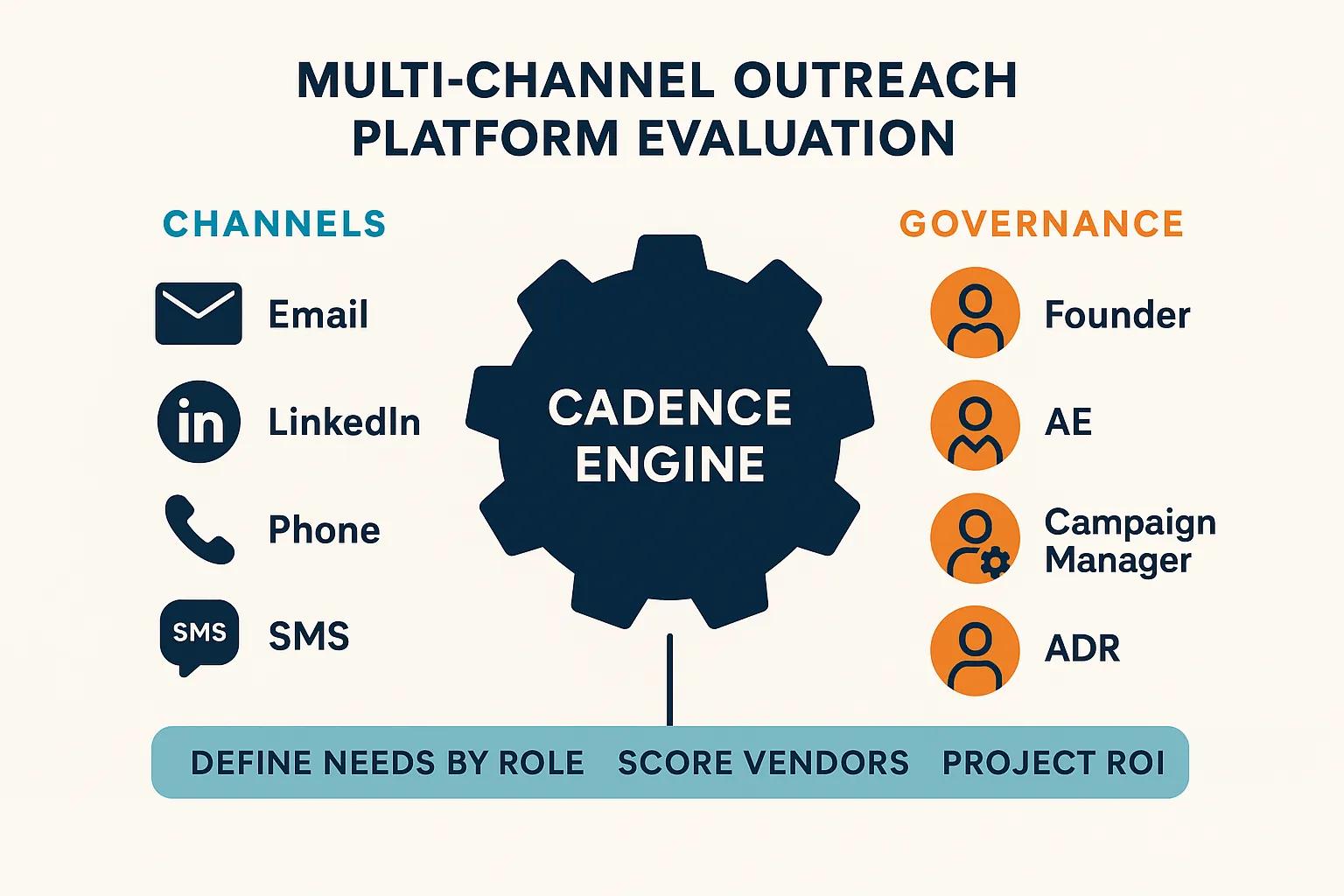
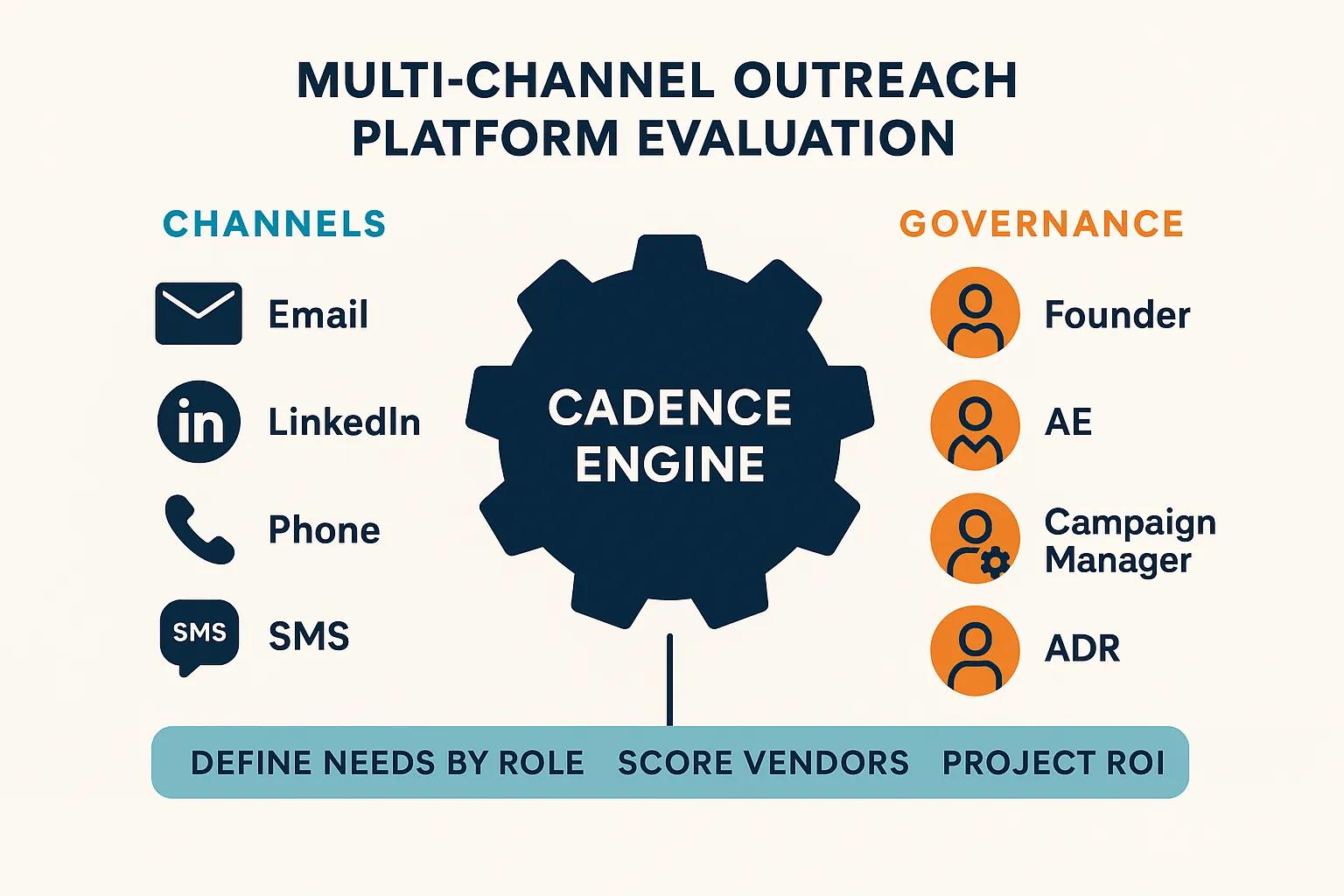
Multi-channel outreach automation commonly includes email, LinkedIn, phone/call sequencing, SMS/WhatsApp, and sometimes in-app chat or social touches; each channel contributes a different engagement role. Email is the workhorse for detailed pitch and content delivery, LinkedIn establishes credibility and warms contacts, phone calls are highest for qualification and intent discovery, and SMS/WhatsApp provide short, timely nudges with strong open rates. Recent engagement benchmarks indicate LinkedIn connection or reply rates often exceed cold email replies on targeted lists, while phone outreach can significantly increase conversion when used after an initial digital touch. Best-practice sequencing uses LinkedIn for introduction and credibility, email for detailed value propositions, and phone or SMS for timely qualification — sequencing that balances persistence with respect for consent and deliverability.
These channel roles inform cadence design and channel weighting, which leads into the measurable outcomes automation should deliver for service providers.
H3: What outcomes can automation deliver for consultants and agencies?
Multi-channel automation aims to produce three measurable outcomes for consultants and agencies: higher reply and meeting rates, reduced manual SDR time per opportunity, and predictable pipeline generation across client portfolios. By automating repetitive tasks and using AI to personalize at scale, teams commonly report time savings that free senior staff to focus on conversion and client work rather than list management. Conversion improvements are typically seen as uplift in reply rate and meeting rate when personalization and timely sequences are combined across channels. Additionally, automation provides scalability: campaigns can be templated and deployed across multiple clients while preserving client-specific messaging and data partitioning to maintain confidentiality.
These results depend on platform features and governance controls, which are the next area to evaluate when choosing a solution.
H2: What features matter most in outreach automation for consultants and agencies?
A prioritized feature checklist helps buyers focus on what matters: channel coverage and sequencing flexibility, AI-powered personalization, CRM and calendar integration, analytics and deliverability tools, and governance/compliance capabilities. The core feature set determines whether a platform can run multi-tenant campaigns, personalize at scale without manual edits, sync prospect and activity data bi-directionally with CRMs, and surface pipeline impact through dashboards. Below is a concise checklist of top features to consider when creating a vendor shortlist.
- Channel Coverage & Sequencing: Support for email, LinkedIn, phone, and SMS with flexible timing and branching logic.
- AI Personalization Engine: NLG-driven variable substitution, intent-aware snippets, and campaign-level template management.
- CRM & Calendar Sync: Bi-directional connectors that keep lead state, activities, and meeting invites in sync.
- Analytics & Deliverability: Deliverability monitoring, reply/meeting dashboards, and pipeline attribution reporting.
- Governance & Compliance: User roles, tenant partitioning, audit logs, and consent management for GDPR/CCPA.
This prioritized checklist clarifies vendor comparisons, and the table below compares core feature trade-offs you should expect across solutions.
| Feature Area | Characteristic | Value for Consultants/Agencies |
|---|---|---|
| Channel Support | Email, LinkedIn, Phone, SMS | Enables multi-touch cadences that increase reply and meeting rates |
| AI Personalization | Template engine, NLG snippets | Scales personalization across many clients without manual edits |
| CRM Connectors | Bi-directional sync with opportunity links | Maintains pipeline accuracy and reduces manual data entry |
| Scalability | Multi-tenant accounts, role controls | Allows agency-level separation of client data and campaign teams |
| Compliance | Audit trails, consent records | Ensures outreach respects GDPR/CCPA and client confidentiality |
This comparison highlights that the strongest platforms balance channel breadth, AI-enabled personalization, and governance to suit multi-client operations.
H3: Core channel coverage, AI-powered personalization, and CRM integration
Core channel coverage should include reliable email sending, LinkedIn automation that respects platform terms, voice/call sequencing with disposition tracking, and SMS for short follow-ups. AI personalization works by combining intent signals, prospect enrichment fields, and template orchestration so the system generates context-aware snippets or subject lines while preserving safety controls and guardrails. CRM integration patterns vary: full bi-directional sync is ideal because it updates lead stage, logs activities, and surfaces campaign outcomes in the CRM; lighter approaches use imports/exports or webhook-based updates that require more manual reconciliation. For consultants and agencies, prioritize platforms offering native connectors to major CRMs and the ability to map custom fields for client-specific contexts.
This shift towards intelligent automation is further explored in studies highlighting the significant improvements in engagement and ROI achieved through AI-driven decision engines that dynamically personalize customer interactions.
AI-Driven Multi-Channel Marketing Automation & ROI
This article examines the paradigm shift from traditional rule-based marketing automation to continuous experience optimization enabled by AI-driven decision engines. The article presents an architectural framework for real-time campaign orchestration systems that leverage predictive analytics, reinforcement learning, and natural language processing to dynamically personalize customer interactions across channels. Through multiple case studies across different industry sectors, the article demonstrates how these systems process multi-source data streams to make intelligent decisions in milliseconds, creating responsive customer journeys that adapt to behavioral signals and contextual cues. The article indicates significant improvements in engagement metrics, customer retention, and marketing return on investment compared to conventional batch-processing approaches.
Algorithmic Campaign Orchestration: A Framework for Automated Multi-Channel Marketing Decisions, 2025
Understanding these integration patterns helps buyers judge implementation effort and data fidelity, which connects to governance, analytics, and compliance needs discussed next.
H3: Governance, analytics, scalability, and compliance considerations
Governance must include user roles, tenant and client data partitioning, and audit logs so agencies can run multiple client campaigns without data leakage. Analytics should report channel-level reply rates, meeting conversion, pipeline created, and cost-per-opportunity so consultants can attribute value and charge clients accordingly. Scalability covers both technical throughput (sending limits, concurrency) and operational features like templating, cloning campaigns, and permissioned workflows. Compliance controls should include explicit opt-out handling, consent recording, email deliverability monitoring, and vendor-provided data processing agreements for GDPR/CCPA. When evaluating vendors, request evidence of audit trails, tenant separation, and sample reports that map outreach activity to pipeline outcomes.
A clear governance and analytics plan reduces risk during rollout and supports accurate ROI projections used in vendor selection.
H2: How to evaluate, compare, and select the right platform for B2B service providers?
Start with a stepwise selection framework that maps requirements to roles, lists essential integrations, and uses feature matrices and ROI projections to compare options objectively. The evaluation process should begin with defining needs by role (founder, AE, SDR, campaign manager) and end with vendor due-diligence on support SLAs and security assessments. Use a scoring matrix to weight features by business impact and calculate expected ROI based on time saved and pipeline yield improvements. Below is the feature matrix structure you can use to compare contenders.
Intro: This table shows how to convert features into business-impact metrics and expected ROI indicators for consultants and agencies.
| Feature | Business Impact | Expected ROI / Metric |
|---|---|---|
| Sequencing & Channel Breadth | Higher engagement and conversion | +% reply rate; meetings per 1000 touches |
| AI Personalization | Reduced manual editing, higher relevance | Time saved per campaign; uplift in meeting rate |
| CRM Bi-directional Sync | Accurate pipeline attribution | Reduced data reconciliation hours; faster forecast accuracy |
| Multi-tenant Governance | Safe multi-client operations | Reduced compliance risk; billable campaign capacity |
| Analytics & Attribution | Clear pipeline measurement | Pipeline created per campaign; cost per opportunity |
- Define needs by role: Map tasks to roles and determine minimum/advanced requirements.
- Prioritize integrations: List required CRM, calendar, and lead enrichment connectors.
- Score vendors: Use weighted scoring for feature importance and vendor proof points.
- Project ROI: Estimate time saved and pipeline uplift to compute payback period.
These steps yield a defensible short list and the next paragraph explains role-based requirements in detail.
H3: Defining needs by role and essential integrations
Map platform capabilities to role responsibilities: founders need quick dashboards and templates, AEs need meeting scheduling and CRM sync, SDRs require sequence management and call logging, and campaign managers need multi-tenant controls and reporting. Integration priorities typically start with CRM and calendar, then lead enrichment and billing/finance systems for agencies. For each role, define a minimal viable capability set and an advanced set to guide vendor scoring and negotiation. Ensure your integration list includes field mapping requirements, frequency of sync, and whether contacts are shared across clients or isolated in separate tenants.
A clear role-to-integration mapping reduces ambiguity during demos and accelerates implementation planning.
H3: Using feature matrices, ROI projections, pricing, and vendor support to compare options
When building comparison matrices, assign weighted scores to features based on business impact and use sample data to model ROI: estimate hours saved per campaign, expected uplift in meetings, and revenue per meeting to calculate cost-per-opportunity. Include vendor support metrics such as onboarding time, SLA response windows, and availability of technical account management as part of the score. Ask vendors for reference data, uptime statistics, and a roadmap for product features. Finally, include a sensitivity analysis showing how different conversion uplifts affect payback period and total lifetime value per client.
This vendor due-diligence ensures the final selection reflects both technical fit and operational support capacity.
H2: How to implement multi-channel outreach workflows for consultants and agencies?
Implementation begins with a phased roadmap: pilot with one client or segment, iterate cadences and personalization templates, then scale via templating and governance. Design sequences that respect consent and cadence fatigue, use A/B testing to tune subject lines and messages, and automate meeting scheduling to reduce friction. Train SDRs and AEs on the platform’s personalization controls and approval workflows so AI-driven messages remain aligned with brand voice. The next sections provide practical cadence design patterns and compliance steps to guide rollout.
These implementation practices ensure pilots produce measurable results that can be scaled across client portfolios.
H3: Designing multi-channel sequences and AI-powered personalization at scale
A practical multi-channel cadence often spans 7–14 days with 4–7 touches combining LinkedIn outreach, two emails, one SMS, and a phone attempt; timing should be adjusted by industry norms and buyer cadence. AI personalization workflows typically use enrichment data and intent signals to populate dynamic fields and generate short, relevant snippets while maintaining canned fallback content for safety. Test small variations with clear KPIs for each sequence, then promote winning variants to templates for reuse across clients. Establish QA steps where campaign managers review AI-generated content for brand and compliance before wide deployment.
These design and testing practices reduce risk while maximizing the chance of early wins and scalable templates.
H3: Ensuring data privacy, ethics, and compliant outreach
Compliance requires explicit opt-out handling, data minimization, and recordkeeping that links consent status to each contact and campaign. Implement tenant data partitioning and access controls so client data is segregated and only authorized users can view or export it. Maintain vendor contract clauses that specify data processing roles and obligations, and require audit logs for message sends and edits. Ethically, avoid hyper-granular profiling that could misrepresent prospects and build review processes for AI-generated claims to prevent misleading statements.
By embedding privacy and ethical checks into workflows, agencies protect client reputations and reduce regulatory risk while scaling outreach.
H2: How to measure success and ROI from a multi-channel outreach solution?
Measuring success requires a clear KPI set, reliable data sources, and regular reporting cadence to translate outreach activity into pipeline and revenue. Focus on channel-level metrics (reply and meeting rates), cadence-level conversion, and value-level metrics (pipeline created, cost-per-opportunity). Use CRM opportunity creation events and outreach platform activity logs as primary data sources and define formulas for each KPI to maintain consistency. The table below standardizes KPI definitions and measurement formulas for agencies and consultants.
Intro: The following KPI table defines key metrics, their formulas, and typical data sources to ensure consistent measurement.
| KPI | Definition | How to Measure (Formula / Data Source) |
|---|---|---|
| Reply Rate | Percent of touches that produce a reply | Replies / Total touches (platform send logs) |
| Meeting Rate | Percent of replies that become meetings | Meetings scheduled / Replies (calendar + platform) |
| Pipeline Created | Value of opportunities sourced from outreach | Sum(opportunity value where source=outreach) from CRM |
| Conversion Rate | Meetings → Opportunities → Closed | Opportunities / Meetings; Closed / Opportunities (CRM) |
| Cost per Opportunity | Spend divided by opportunities created | Total outreach cost / Number of opportunities |
- Track channel-level KPIs: Measure email, LinkedIn, phone, and SMS separately.
- Attribute pipeline correctly: Use CRM rules to tag opportunities from outreach campaigns.
- Report cadence performance: Run weekly cadence reports to optimize messaging and timing.
Using these measurement practices allows agencies to prove campaign impact and iterate based on evidence.
H3: Key KPIs for B2B outreach and pipeline impact
Key KPIs include reply rate, meeting rate, pipeline created, conversion rate from meeting to opportunity, and cost-per-opportunity; each must have a clear data source and formula. Reply rate is measured as replies divided by touches and helps assess message relevance, while meeting rate links replies to booked conversations and measures success in progressing prospects. Pipeline created totals opportunity values attributed to outreach and should be reconciled with CRM data to avoid double-counting. Cost-per-opportunity divides total outreach cost (platform + staffing) by opportunities created, which is essential for pricing services and proving ROI to clients.
Consistent KPI definitions enable fair vendor comparisons and trusted internal reporting, which supports scaling outreach investments.
H3: Using case studies and industry benchmarks to validate ROI
Craft short case studies in the format: challenge → approach → metrics → outcome, focusing on before/after KPIs and revenue impact to make ROI tangible for stakeholders. Use credible benchmarks from industry reports and your own historical data to set realistic targets for reply and meeting rates by channel. Present sensitivity analyses showing how conservative and optimistic conversion rates affect net ROI and payback period. When vendors provide benchmark claims, ask for anonymized examples and verify through pilot campaigns before committing to long-term contracts.
Documented case studies and benchmark comparisons close the loop between experimentation and scaled deployment, helping teams make evidence-based vendor choices.
Frequently Asked Questions
1. What are the key benefits of using multi-channel outreach automation for B2B service providers?
Multi-channel outreach automation offers several key benefits for B2B service providers, including increased efficiency, improved engagement rates, and enhanced scalability. By automating outreach across various channels like email, LinkedIn, and SMS, teams can save time on repetitive tasks and focus on high-value activities. This approach also allows for personalized messaging at scale, leading to higher reply and meeting rates. Additionally, automation helps maintain compliance and client confidentiality while enabling agencies to manage multiple client campaigns effectively.
2. How can I ensure compliance with data privacy regulations when using outreach automation?
To ensure compliance with data privacy regulations such as GDPR and CCPA while using outreach automation, agencies should implement explicit opt-out mechanisms, maintain accurate consent records, and ensure data minimization practices. It's crucial to establish tenant data partitioning to segregate client data and restrict access to authorized users only. Additionally, agencies should include clauses in vendor contracts that outline data processing responsibilities and maintain audit logs for all outreach activities to demonstrate compliance and accountability.
3. What role does AI play in multi-channel outreach automation?
AI plays a significant role in multi-channel outreach automation by enabling personalized messaging and optimizing engagement strategies. AI-driven personalization engines analyze prospect data and intent signals to generate context-aware content, such as tailored email snippets or subject lines. This technology allows outreach teams to automate the customization of messages at scale, improving relevance and increasing the likelihood of responses. Furthermore, AI can help in analyzing campaign performance, providing insights that guide future outreach efforts and enhance overall effectiveness.
4. How do I measure the success of my multi-channel outreach campaigns?
Measuring the success of multi-channel outreach campaigns involves tracking key performance indicators (KPIs) such as reply rates, meeting rates, and pipeline creation. Agencies should establish clear definitions and formulas for each KPI, using reliable data sources like CRM logs and outreach platform activity. Regular reporting on these metrics allows teams to assess the effectiveness of their campaigns, identify areas for improvement, and make data-driven decisions to optimize future outreach efforts. Consistent measurement practices also facilitate vendor comparisons and internal reporting.
5. What are the common challenges faced during the implementation of outreach automation?
Common challenges during the implementation of outreach automation include ensuring data integrity, managing user roles and permissions, and aligning the automation with existing workflows. Agencies may also face difficulties in training staff to effectively use the new platform and in maintaining compliance with data privacy regulations. Additionally, integrating the automation solution with existing CRM systems can pose technical hurdles. To mitigate these challenges, agencies should adopt a phased implementation approach, provide comprehensive training, and establish clear governance protocols.
6. How can I select the right multi-channel outreach automation platform for my agency?
Selecting the right multi-channel outreach automation platform involves a systematic evaluation of your agency's needs and the features offered by various vendors. Start by defining the specific requirements based on roles within your agency, such as founders, SDRs, and campaign managers. Create a feature matrix to compare platforms based on essential capabilities like channel coverage, AI personalization, and CRM integration. Additionally, consider vendor support, compliance features, and scalability options. Conducting thorough due diligence and requesting demos can further aid in making an informed decision.
7. What are the best practices for designing effective multi-channel outreach sequences?
Designing effective multi-channel outreach sequences involves creating a balanced cadence that incorporates various touchpoints, such as emails, LinkedIn messages, and phone calls. Best practices include spacing out touches to avoid overwhelming prospects, using A/B testing to refine messaging, and personalizing content based on prospect data. It's also important to establish clear KPIs for each sequence to measure performance and make adjustments as needed. Regularly reviewing and iterating on sequences based on feedback and results can help optimize engagement and conversion rates over time.
