
Contextual Messaging AI: Nigel's Approach to Personalization
How Nigel Uses Deep Attention Filtering for Personalised, AI-Driven Lead Generation

Nigel the AI uses a focused technique called Deep Attention Filtering to surface the signals that matter most for outreach. By weighting context — recent posts, company events, role changes — Nigel crafts LinkedIn messages that feel timely and relevant, improving reply rates and producing higher-quality leads. This article walks through what Deep Attention Filtering is, how it differs from standard personalization, and the core AI building blocks behind it so you can judge both technical trade-offs and business value. Many sales teams see low replies and wasted research because one-size-fits-all automation misses context; Deep Attention Filtering fixes that by prioritising the right signals at the right time. You’ll get a clear explanation of the mechanics, concrete LinkedIn workflows that show how contextual messages are built, measurable benefits for sales teams, and the lead-scoring logic that speeds handoffs to reps. Practical tables and step-by-step lists make the link between attention mechanisms and real sales outcomes easy to follow. Relevant keywords like deep attention filtering, ai personalization, contextual messaging ai and personalised LinkedIn outreach are woven through the piece to help discovery and clarity.
What Is Deep Attention Filtering and How Does It Improve Personalization?
Deep Attention Filtering is a model-level strategy that learns to assign soft weights to mixed signals so the system concentrates on features most predictive of engagement and buying intent. The pipeline ingests profile and activity data, builds semantic representations, and uses attention layers to boost signals that match a prospect’s current needs. The result: messages that reference timely, specific details instead of relying on generic templates. Practically, this produces two main wins — more relevant outreach that raises reply rates, and smarter signal prioritisation that cuts false positives when qualifying leads. Below we compare Deep Attention Filtering with traditional personalization and show why attention-focused models reduce noise while increasing precision.
AI-Driven Personalisation: Deep Learning Versus Filtering Algorithms
As digital advertising and recommendations evolve, personalization has become essential for stronger engagement and better conversion. This research draws on a large e‑commerce dataset — user demographics, past behaviour, and feedback — to compare algorithms. It evaluates collaborative filtering for leveraging user similarity, content-based filtering for using item attributes, and deep learning methods for uncovering complex, non-linear patterns in the data. Enhancing digital ad personalization with ai: A comparative study of collaborative filtering, content-based filtering, and deep learning algorithms, A Sharma, 2022
Unlike rules-based systems or simple machine-learning scorers, Deep Attention Filtering learns context-sensitive weights instead of applying rigid heuristics. A rules engine might flag any leadership title; attention models learn when that title actually matters — for example, boosting the signal when a senior product lead posts about vendor evaluation. That adaptability cuts down on irrelevant outreach, preserves sender reputation, and raises the intent behind replies. With that distinction clear, we can examine the technologies that make Deep Attention Filtering workable in production.
Which AI technologies power Deep Attention Filtering in Nigel?
Deep Attention Filtering is powered by several complementary components: attention mechanisms and transformer-style models to weight context, NLU/NLP to understand profile and post text, and real-time data pipelines for low-latency signal ingestion. Transformers produce contextual embeddings that let the system compare diverse inputs — job moves, posts, company news — in the same semantic space. NLU extracts entities and intents that become features for attention, while real-time feature engineering converts streaming LinkedIn signals into normalized inputs so attention weights can update instantly. Together, these pieces let Nigel prioritise high-signal context and generate personalised outreach at scale.
| Data Source | Signal Type | Example |
|---|---|---|
| Profile information | Role, seniority, industry | "Head of Product", SaaS, enterprise |
| Recent activity | Post content, comments, shares | Article on vendor selection, keynote mention |
| Company events | Funding, hiring, product launches | Series B funding announcement |
| Public signals | Press, job board changes | Job posting for implementation manager |
This table shows how diverse inputs feed the attention layer and why combining them improves contextual matching. Next, we map those weighted signals into LinkedIn outreach pipelines to show the end-to-end flow.
How Does Nigel Apply Deep Attention Filtering for LinkedIn Lead Generation?
Nigel runs Deep Attention Filtering through a clear, stepwise workflow: discover prospects, weight context signals, draft tailored messages, and sequence follow-ups to lift meeting conversion. Discovery starts with role and firmographic filters, then candidates are enriched with activity and intent signals. Attention-based ranking prioritises outreach, and personalisation happens at message composition, where the top-weighted signals set tone, references, and the call-to-action. Replies feed back into the model so the system refines itself continuously. The sequence below shows how each phase contributes to more contextual LinkedIn outreach.
- Identify potential prospects with role and firmographic filters and pull in recent activity signals.
- Compute semantic embeddings for profile text and posts, then apply attention weights to rank signals.
- Draft personalised message candidates that reference the highest-weighted context, enforce safeguards to avoid spammy details, and schedule sends.
- Track replies and engagement, update lead scores in real time, and adapt follow-up sequences to response patterns.
This flow explains how attention weighting converts raw LinkedIn inputs into high-relevance outreach. In practice, Nigel operates as an AI-powered sales representative for LinkedIn top-of-funnel tasks, automating discovery and qualification while keeping contextual nuance intact. We present these details so potential users can evaluate Nigel’s capabilities and value proposition.
What role does contextual AI messaging play in Nigel’s outreach?

Contextual AI messaging shifts relevance away from static profile fields and toward dynamic, semantically rich signals that reflect what’s important now. Referencing a recent post, company milestone, or role change helps messages land as timely and sincere rather than cold. Context also guides timing and tone: a celebratory announcement calls for a brief congratulations, while a post about technical pain points invites a consultative, solution-focused opener. Using context this way raises perceived authenticity and increases reply likelihood, which the model then uses to refine attention weights for future outreach.
How are personalised LinkedIn messages generated using Deep Attention Filtering?
Message generation begins with signal extraction and attention-driven selection of the most salient details to reference. The pipeline either augments templates or produces generative phrasing tailored to that context, with safety filters to prevent overly specific or private mentions. Message length and CTA type are chosen based on predicted receptivity. For example, an opener might mention a recent article the prospect shared, note a related challenge, and suggest a short exploratory call — all anchored to top-weighted signals. These safeguards keep personalization meaningful, compliant with platform norms, and scalable across many prospects.
What Are the Benefits of Nigel’s Deep Attention Filtering for Sales Teams?
Deep Attention Filtering delivers measurable gains for sales teams: higher engagement per outreach, better lead quality at handoff, and less time wasted on low-probability prospects. At its core, attention improves the signal-to-noise ratio by surfacing contextual cues that correlate with buying behaviour, which raises conversion from first touch to meeting. Operationally, Nigel reduces researcher hours by automating context discovery and prioritisation, freeing reps to focus on closing. Below are the primary business outcomes teams typically prioritise when adopting attention-driven personalization.
- Higher reply and meeting rates from more relevant, timely messaging.
- A larger share of qualified leads passed to sales, cutting wasted outreach.
- Time savings through automated discovery and scoring, so reps spend more time selling.
Those benefits translate into measurable pipeline improvements and let sales ops reallocate resources toward higher-value activities — we quantify these effects in the case-study section that follows.
| Feature | Mechanism | Business Outcome |
|---|---|---|
| Context-weighted messaging | Attention amplifies relevant signals | Higher engagement and reply rates |
| Real-time scoring | Low-latency updates to lead score | Faster outreach on fresh intent |
| Semantic message generation | NLU-informed, context-aware text | Better quality conversations and meetings |
This mapping shows how model design choices translate into operational improvements that move revenue metrics. The next section digs into how automated outreach lifts engagement.
How does automated, personalised outreach improve engagement rates?
Automated, personalised outreach pairs relevance with consistent timing: the system references recent cues and follows up intelligently, increasing the odds of reaching a prospect when they’re receptive. Personalisation creates cognitive resonance — prospects see messages tied to their recent activity or priorities — while automation ensures those messages go out promptly when intent signals spike. Benchmarks show context-aware messages outperform generic sequences, and attention filtering further cuts false positives that hurt sender reputation. Combined, relevance plus speed leads to higher engagement and stronger downstream conversion.
In what ways does AI-driven lead qualification save time and increase conversions?
AI-driven qualification replaces manual research with a single, interpretable lead score that captures both fit and intent, so reps focus on the best opportunities. Automated filters remove low-probability leads and highlight prospects with compound signals — for example, a role change plus active engagement — which statistically predict higher conversion. The net effect: shorter cycles and improved rep productivity because fewer touches are wasted on poor-fit prospects and more time goes to negotiation and closing.
How Does Nigel’s AI Lead Qualification Work Using Deep Attention Filtering?
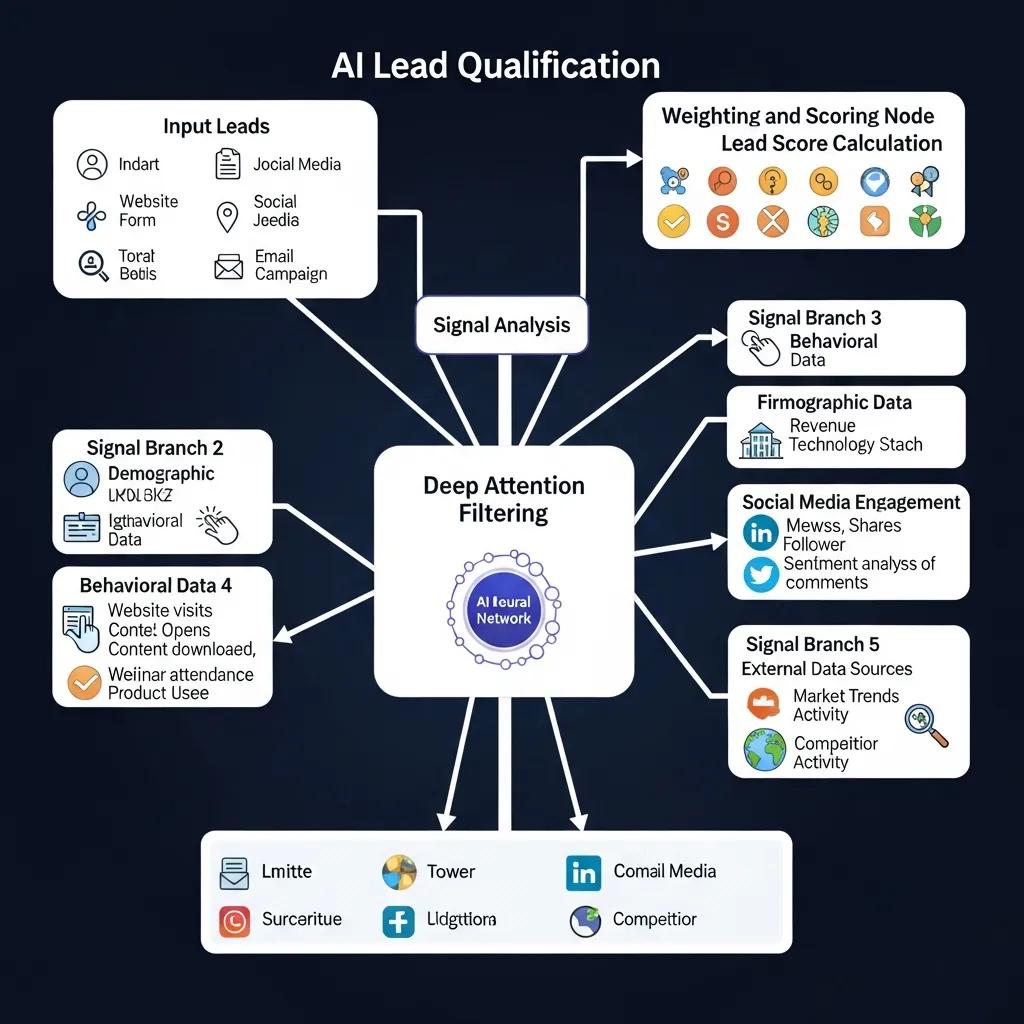
Nigel’s qualification logic combines attention-weighted features with a scoring model that aggregates multiple buying signals into an interpretable lead score for prioritisation and handoff. Inputs — profile attributes, content interactions, company events — are normalised into features, then learned attention weights emphasise signals that historically predict conversion for similar prospects. Scores are bucketed into qualification bands and updated in real time as new signals arrive, enabling outreach when intent spikes. The design supports transparency and continuous learning because each signal’s contribution to the score can be inspected and tuned.
What buying signals does Nigel analyse to score leads?
Nigel evaluates a mix of profile, activity, and external-event signals to estimate interest. Common indicators include role or title changes (new responsibility), content engagement (likes, comments on relevant topics), company events (funding, hiring, product launches), and behavioural cues such as product-page visits or content downloads when available. Each signal has a direction and magnitude effect on score, and signals can compound to raise priority. The table below maps common signals to type and typical score impact.
| Buying Signal | Signal Type | Score Impact |
|---|---|---|
| Role change | Profile change | Positive (raises priority) |
| Funding announcement | Company event | Positive (increases urgency) |
| Content engagement | Behavioural interaction | Positive (indicates interest) |
| Reduced activity | Negative indicator | Negative (lowers priority) |
This structured view helps sales ops see which signals drive prioritisation and why some leads surface earlier than others. The next section explains how streaming updates improve scoring accuracy.
How does real-time data analysis enhance lead scoring accuracy?
Real-time analysis keeps lead scores aligned with the prospect’s current context, enabling outreach at moments of high receptivity — right after a funding round, or when someone posts about a pain point. Low-latency updates also let the system de-prioritise leads when signals fade, protecting rep attention for active opportunities. Continuous feedback — where reply outcomes feed back into the model — refines attention weights over time and adapts scoring to changing market behaviour. That immediacy and learning loop boost precision and shorten time-to-engagement.
What Are Real-World Examples of Nigel’s Personalization Success with Deep Attention Filtering?
Concrete examples demonstrate how Deep Attention Filtering converts scattered signals into pipeline gains through targeted outreach and rapid qualification. The short case-style summaries below show common challenge → DAF action → outcome sequences sales teams can expect from attention-driven personalization. Each example focuses on measurable change to highlight practical impact.
- Challenge → DAF action → measurable outcome: Low reply rates to inbound sequences → Attention-weighted messages referencing recent product posts → Significant uplift in reply rate and 20–30% more meetings booked.
- Challenge → DAF action → measurable outcome: Excessive time spent researching prospects → Automated context aggregation and scoring → Research time cut dramatically and reps closed more deals per month.
- Challenge → DAF action → measurable outcome: Missed timely outreach after company events → Real-time event detection and immediate outreach → Higher conversion from event-triggered contacts to qualified discussions.
How have businesses increased qualified leads using Nigel’s AI personalisation?
Companies using attention-based personalization typically see bigger volumes of qualified leads because Nigel prioritises prospects with stacked intent signals and sends more relevant sequences. Teams often move initial discovery to Nigel’s automation and let human sellers engage after a qualification threshold — resulting in a larger funnel of higher-fit opportunities. Comparing qualified leads per rep per month before and after deployment is a straightforward way to quantify the operational uplift and justify further investment in automation and model tuning.
What measurable outcomes demonstrate the impact of Deep Attention Filtering?
Common KPIs that improve with Deep Attention Filtering include reply rate, meeting conversion rate, time-to-first-meeting, and researcher hours saved — tracking these gives concrete ROI. Better reply and meeting rates speed pipeline velocity, while reduced manual research and improved lead-to-opportunity ratios lower customer acquisition costs. Teams should measure these metrics over time to attribute gains to attention-driven personalization and to guide model refinements.
What Common Questions Do Users Have About Deep Attention Filtering and Nigel’s AI Personalization?
What is deep attention in AI and why is it important?
Deep attention refers to model components that learn to focus on the most relevant parts of input data by assigning dynamic weights. That ability matters because it lets personalization systems surface context that actually drives engagement instead of leaning on brittle rules or single-field matches. In practice, attention reduces irrelevant outreach, improves reply quality, and supports more accurate lead scoring by learning which signals deserve priority.
How does AI personalize content for LinkedIn lead generation?
AI personalises LinkedIn outreach by collecting profile and activity signals, converting them into semantic features via NLU, and then using attention weights to decide which details to surface. The pipeline usually includes signal ingestion, attention-based ranking, template or generative phrasing, and follow-up sequencing shaped by engagement. A short example might reference a prospect’s recent post about scaling, propose a brief idea exchange, and offer a flexible next step — all drawn from top-weighted signals.
- Respecting data privacy and platform policies is essential when extracting signals and composing messages.
- Safeguards are needed to avoid over-personalisation that can feel intrusive.
- Continuous monitoring and human-in-the-loop review strengthen model performance and trust.
These practices guide responsible deployment of attention-driven personalization. For teams evaluating solutions, Nigel the AI implements Deep Attention Filtering as its core personalization engine to power LinkedIn lead generation. We present these details so teams can decide whether to explore or adopt the platform.
What are the next steps for teams considering attention-driven personalization?
Start by identifying high-volume, low-reply segments where contextual relevance could move the needle, then run a narrow pilot to measure reply and meeting lift. Instrumentation matters: capture baseline KPIs, track the same metrics during the pilot, and require explainability so ops can see which signals change scores. Iterate with rep feedback to refine attention weights and messaging before rolling out more broadly.
Practically, run a time-boxed pilot that measures engagement uplift, qualification rate, and time saved; use that evidence to scale and integrate with your CRM and sales workflow. We provide these recommendations to help teams assess Nigel the AI’s fit for their outreach strategy.
Conclusion
Deep Attention Filtering changes how LinkedIn lead generation works by making outreach more relevant and higher quality, which in turn drives better engagement. By leaning on contextual signals, sales teams save time and concentrate on higher-potential leads, improving conversion rates and pipeline efficiency. Adopting this approach can materially strengthen your sales strategy — explore Nigel the AI to see how attention-driven personalization could lift your outreach results.
