
Unlock LinkedIn Lead Generation with AI-Powered Techniques
Mastering LinkedIn Lead Generation with AI: Strategies, Tools, and Automation for B2B Success

Introduction
AI-powered LinkedIn lead generation transforms manual prospecting into a data-driven funnel that surfaces higher-quality B2B opportunities faster. This guide explains how AI enhances LinkedIn prospecting, personalization, automation, profile optimization for LLMs, measurement, and advanced outreach tactics so teams can convert with greater efficiency and predictability. Many sales teams struggle with noisy lists, low reply rates, and profiles that AI agents and large language models misinterpret; solving these problems produces clearer signals, better prioritization, and more meaningful conversations. In the sections that follow you will get practical strategies for defining and expanding an ideal customer profile, a concise comparison of tool categories that integrate with LinkedIn Sales Navigator, stepwise methods to make profiles machine-readable, a KPI-driven measurement framework, and advanced multi-channel orchestration patterns. Throughout, keywords like linkedin lead generation, ai linkedin prospecting, linkedin automation, and AI trust signals are used to connect tactics with implementation examples and measurement approaches.
What Are the Best AI LinkedIn Lead Generation Strategies for B2B?
AI-driven LinkedIn lead generation strategy blends automated data enrichment, predictive prioritization, and scalable personalization to increase acceptance and reply rates while reducing wasted outreach. At its core, AI analyzes profile signals, company attributes, and engagement patterns to expand an ICP and rank prospects by likely fit and intent, producing better lists and faster outreach outcomes. The result is a prioritized pipeline where outreach resources focus on accounts and contacts most likely to engage, improving conversion velocity and pipeline quality. Below are practical strategies to adopt now and how they map to implementation.
Use AI to define and expand your Ideal Customer Profile (ICP), combining firmographic and behavioral signals for higher-precision targeting.
Automate repetitive prospecting tasks while preserving personalized openers and contextual hooks to maintain authenticity.
Combine predictive lead scoring with outreach prioritization so sales reps work hot leads first and reduce time-to-first-contact.
Apply AI to generate tailored connection requests and follow-ups, then A/B test message variants to continually improve response rates.
These strategies work together: ICP refinement produces better targets, automation scales outreach, and scoring prioritizes human attention where it matters most, which leads into how AI enhances prospecting and profiling.
How Does AI Enhance Prospecting and Ideal Customer Profiling on LinkedIn?
AI enhances prospecting by enriching basic LinkedIn search results with similarity scoring, clustering, and intent signal overlays that uncover lookalike audiences and rising opportunities. Data sources include profile headlines, activity signals, company size, technology stack mentions, and public content engagement; AI clusters these signals to surface patterns that manual lists miss. The mechanism—vector similarity and supervised ranking—lets teams expand an ICP from a handful of known good accounts into hundreds of high-probability prospects. As a result, outreach lists are shorter, higher-signal, and easier to prioritize, improving contact acceptance and reply metrics. Understanding this enrichment process paves the way to using AI for message personalization at scale.
What Role Does AI-Powered Personalization Play in LinkedIn Outreach?
AI-powered personalization assembles contextually relevant snippets from profiles and company pages to craft openers that reference recent activity, mutual connections, or precise pain points, increasing trust and response likelihood. Techniques range from dynamic variable substitution to short contextual summaries that frame a one-line value proposition tailored to the prospect's role and company stage. Best practice is to generate multiple message variants, run controlled A/B tests, and require human review for top-tier accounts to prevent off-tone or inaccurate personalization. Scaled personalization—when combined with timing based on intent signals—boosts acceptance and reply rates while preserving authenticity and compliance with platform norms.
Research further supports the efficacy of large language models in generating and refining high-quality content for LinkedIn outreach.
LLM-Powered Content Creation for LinkedIn Lead Generation
This study explores the use of large language models (LLMs), such as ChatGPT and GPT-4, in creating high-quality text-based social media content for businesses on LinkedIn. We introduce a novel architecture incorporating external knowledge bases and a multi-step writing approach, which extracts facts from company websites to form a knowledge graph. Our method’s efficacy is assessed using the “Long-LinkedIn” evaluation dataset designed for long-form post generation. Results indicate that our iterative refinement significantly improves content quality. However, knowledge-enhanced prompts occasionally reduced quality due to potential formulation issues. LLM-based evaluations, particularly using ChatGPT, showcased potential as a less resource-intensive alternative to human assessments, with a notable alignment between the two evaluation techniques.
Formalizing content creation and evaluation methods for AI-generated social media content, A Højmark, 2023
Which AI Tools Are Most Effective for LinkedIn Prospecting and Automation?
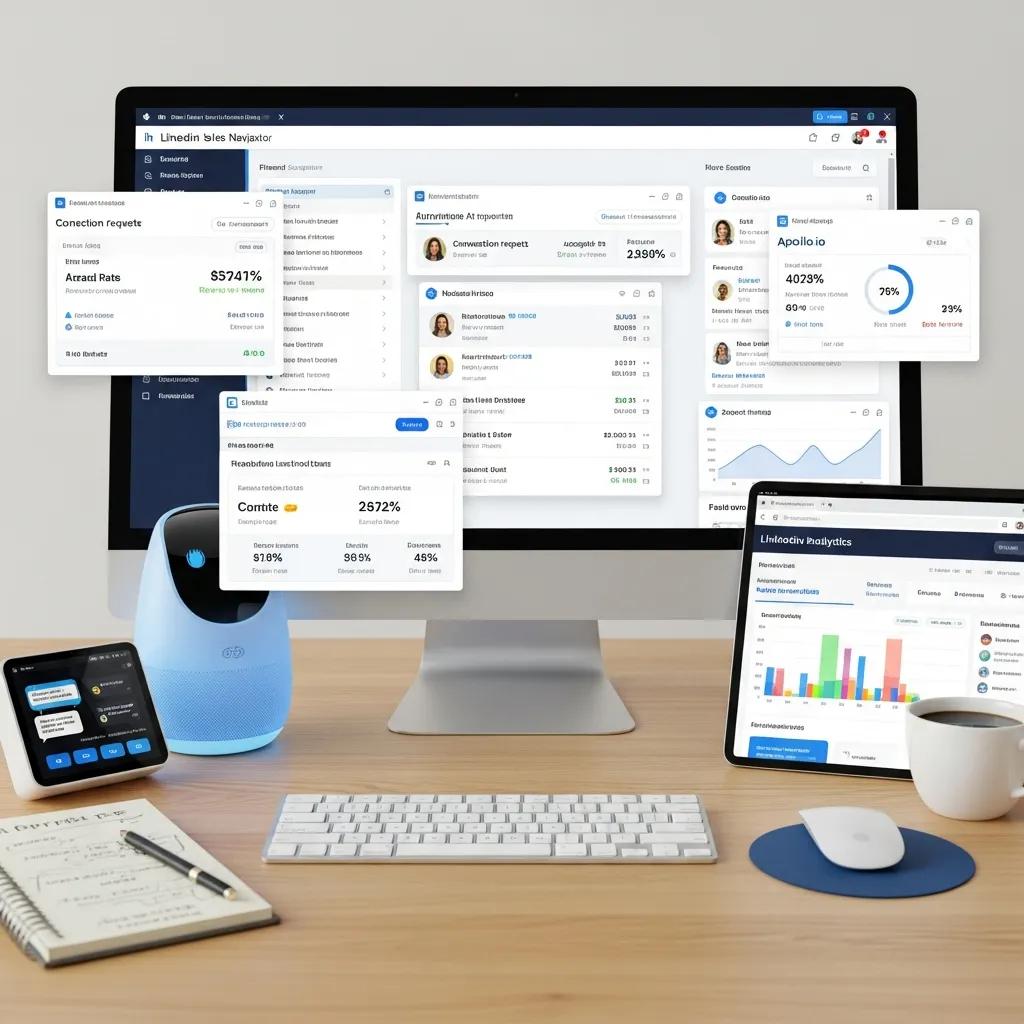
AI tools for LinkedIn prospecting fall into categories: prospecting/enrichment engines, message personalization assistants, automation/sequencing platforms, and analytics/lead-scoring systems. The most effective setups combine a Sales Navigator-enabled search with enrichment and scoring layers plus an automation engine that sequences messages and records outcomes in a CRM. Evaluation criteria are accuracy of enrichment, quality of personalization, ease of integration with Sales Navigator and CRMs, and respect for privacy and platform terms of service. Choose tools that provide clear exportable signals and opt for modular stacks so you can swap components as models and terms evolve.
Before the comparison table below, note this quick list of tool categories to consider when designing an AI LinkedIn stack:
Prospecting and enrichment engines that append firmographic and intent signals to lists.
Personalization assistants that draft context-aware openers and follow-ups.
Automation platforms that orchestrate send/wait/follow-up sequences and log outcomes.
Analytics and lead-scoring systems that prioritize outreach and measure conversion impact.
This category breakdown leads into a structured comparison of representative capabilities and best-use cases.
Intro to tools comparison table: The table below compares core capability, integration ease with LinkedIn Sales Navigator, and ideal use case to help select the right mix for prospecting, personalization, automation, and analytics.
Tool CategoryCore CapabilityLinkedIn IntegrationBest Use CaseProspecting & EnrichmentData augmentation and similarity scoringHigh (exports to CSV/CRM)Expand ICP and generate high-signal listsPersonalization AssistantsContextual message generationMedium (API or manual input)Scaled tailored openers and follow-upsAutomation & SequencingSend/wait/follow-up orchestrationMedium (works with Sales Navigator workflows)Scalable cadence execution with CRM loggingAnalytics & ScoringPredictive lead scoring and reportingHigh (CRM-integrated dashboards)Prioritize outreach and measure ROI
This comparison clarifies where each category adds value and which combination supports a robust AI-enabled LinkedIn stack.
What Are the Top AI Platforms Integrating with LinkedIn Sales Navigator?
Platforms that integrate with Sales Navigator typically focus on enrichment, scoring, or outreach orchestration and either complement native searches or automate downstream sequencing. Integration flows vary: enrichment platforms annotate Sales Navigator exports with intent scores and firmographics, personalization assistants ingest profile fields to draft messages, and automation platforms run cadences using exported lists while syncing results back to CRMs. Choose native Sales Navigator features for targeted boolean searches and use third-party connectors for enrichment, scoring, or sequencing when you need automation at scale. Consider privacy and LinkedIn terms when selecting connectors and prefer solutions that provide explicit integration patterns and audit trails.
Integration patterns suggest using Sales Navigator for high-precision boolean sourcing, an enrichment layer for intent signals, and an automation layer only for sequencing while ensuring CRM synchronization. This pattern leads into how automation sequences are constructed and where personalization injections occur.
How Do AI Automation Tools Streamline LinkedIn Connection Requests and Messaging?
AI automation tools streamline messaging by creating workflows that send a personalized connection request, wait for a configurable interval, and then trigger follow-ups crafted with context-aware AI templates.
Typical sequences include an initial connection message, two staged value-add follow-ups, and a re-engagement message if the prospect goes dormant; AI injects profile-derived hooks into each step.
Recommended cadence respects platform rate limits and human review for high-value accounts to avoid spammy tone.
When automation is paired with dynamic personalization and lead scoring, teams preserve authenticity while scaling outreach, and the next step is ensuring profiles and company pages present clear signals for AI to use.
How Can You Optimize Your LinkedIn Profile and Company Page for AI Understanding?

Optimizing LinkedIn assets for AI understanding means applying entity clarity, narrative consistency, and structured attributes so large language models and AI agents can confidently identify who you are, what you do, and who you serve. The mechanism is straightforward: explicit, consistent descriptors across headline, about, experience, and company descriptions reduce ambiguity and increase the likelihood an AI will recommend or surface the profile. The benefit is improved discoverability when recruiters, prospects, or AI systems query for solutions you offer, which increases organic inbound relevance and prioritization. Below are stepwise actions to implement entity clarity and trust signals.
Step-format actionable tips:
Use a clear headline that names your role and primary value proposition in plain terms.
In the About section, state who you serve, the solution category, and specific outcomes in short bullet points.
Ensure company page descriptions mirror profile phrasing and include structured attributes like service types and target industries.
These steps form the basis for a semantic mapping table that links profile elements to semantic goals and examples.
Intro to profile EAV table: The following table maps specific profile elements to semantic goals and provides concrete implementation examples to help engineers and marketers apply entity clarity rigorously.
Profile ElementSemantic GoalImplementation ExampleHeadlineClear role + value"Head of Demand Gen — B2B SaaS growth for security teams"About / SummaryWho + what + outcomeBullet list: audience, services, measurable outcomesExperience TitlesConsistent descriptorsUse "Product-Led GA for mid-market SaaS" not creative titlesCompany DescriptionService taxonomy + audienceState service categories and core clientele explicitly
This mapping clarifies how small, consistent edits across assets improve AI understanding and sets up the use of trust signals described next.
Integration: Nigel AI Visibility service blurb (business integration)
For organizations seeking a thorough audit and implementation path to achieve entity clarity and AI trust signals on LinkedIn profiles and company pages, Nigel AI Visibility offers an AI visibility audit and implementation service. The service evaluates narrative consistency, identifies ambiguous descriptors that confound LLMs, and recommends structural and content changes to improve machine readability and recommendation likelihood. This external audit and subsequent implementation create a durable AI understanding layer that helps ensure your business is described and recommended accurately by modern AI systems.
Summary paragraph: Establishing entity clarity and aligning trust signals across profile and company assets improves the semantic signals AI systems use to surface and recommend your business, and the practical steps above create immediate, measurable improvements.
What Is Entity Clarity and Why Is It Crucial for AI-Driven Lead Generation?
Entity clarity means explicitly stating your identity, core offerings, and target audience in a way that minimizes ambiguity for both humans and AI agents. Ambiguous or marketing-heavy phrasing leads LLMs to hedge or omit recommendations, while explicit statements enable direct semantic linking between queries and your entity. Concrete steps include consistent naming conventions, concise service bullets, and aligned company descriptors; these reduce AI uncertainty and increase the chance your profile appears when relevant queries are posed. Clear entity definitions also improve downstream tasks—like AI-powered personalization—because systems can reliably extract role, solution, and outcome attributes from your profile.
This focus on clarity naturally leads to adding trust signals and narrative consistency to further boost discoverability.
How Do AI Trust Signals and Narrative Consistency Improve LinkedIn Discoverability?
Trust signals—case study summaries, quantified results, endorsements, and consistent terminology—reduce AI uncertainty and make it more likely an LLM will reference or recommend your business. Narrative consistency means the same phrases and taxonomy appear across profile, company page, and public content so entity linking algorithms can connect disparate mentions reliably. Place concise metrics and outcome statements in the About section and company description; use endorsements and public citations as corroborating evidence. When trust signals and consistency are present, AI generates more confident descriptions and is likelier to surface your entity in relevant recommendation contexts.
What Are the Best Practices for Measuring AI-Driven LinkedIn Lead Generation Success?
Measurement for AI-driven LinkedIn campaigns combines traditional funnel KPIs with AI-specific visibility signals to capture both human engagement and machine recognition improvements. Define metrics for lead quality, response velocity, and conversion efficiency alongside measures for AI understanding such as changes in AI-generated descriptions or the frequency of LLM recommendations. The mechanism of measurement links enriched prospect attributes and lead scoring outputs to downstream outcomes—reply rates, meetings booked, and sourced revenue—enabling tight attribution. Below are prioritized KPIs and a table mapping evaluation attributes to recommended metrics.
Key KPI list with brief definitions:
Acceptance Rate: Percentage of connection requests accepted.
Reply Rate: Percentage of accepted contacts who respond.
Conversion Rate: Percentage of replies that convert to qualified meetings.
The EAV table below maps evaluation attributes to recommended measurable metrics for clear reporting and iteration.
Intro to KPI table: Use this mapping to structure dashboards that combine LinkedIn engagement signals with lead quality and conversion metrics.
Evaluation AttributeMetricRecommended MeasurementLead QualityFit score distributionAverage predictive-fit score of accepted contactsResponse RateReply rateReplies per 100 connection requestsConversion VelocityTime-to-meetingMedian days from connection to meetingAI VisibilityLLM mention frequencyCount of AI-generated mentions or recommendation events
Summary paragraph: Tracking these KPIs together enables teams to see both the operational impact of AI-enabled outreach and shifts in AI recognition that affect long-term discoverability.
Integration: Nigel AI Visibility monitoring mention (business integration)
For teams that need ongoing validation of how LLMs and AI systems recognize and recommend their business over time, Nigel AI Visibility provides monitoring and measurement capabilities that track entity clarity improvements and changes in AI-generated descriptions. Continuous monitoring helps prioritize content and structural updates that increase the probability of being surfaced by AI agents and informs iterative changes to profiles, company pages, and public content.
How Does AI Lead Scoring Improve Conversion Rates on LinkedIn?
AI lead scoring improves conversion by ranking prospects on attributes like fit, behavioral intent, and engagement signals so sales resources focus on the highest-probability contacts first. Scores are constructed from features such as role match, recent activity, firmographic fit, and interaction with prior outreach; these combine into a predictive score that triggers sequencing rules and personalized templates. Implementing scoring reduces wasted outreach, shortens sales cycles, and increases meeting-to-deal conversion by ensuring timely and relevant follow-up.
The scoring model should be continuously validated against conversion outcomes and refined via A/B testing to maintain accuracy.
Which Analytics and ROI Metrics Should You Track for AI-Powered Campaigns?
Track a balanced set of analytics that tie engagement to revenue: acceptance rate, reply rate, conversion rate, deal velocity, and revenue per sourced lead, plus AI-focused metrics like LLM mention/impression frequency and changes in AI-generated descriptions.
Use cohort analysis to compare model-driven outreach versus control groups, and attribute sourced deals by tagging CRM entries created from LinkedIn sequences. Report on cadence performance and model lift regularly to iterate on targeting and messaging, and set a monthly review cadence to align AI adjustments with commercial goals.
How Can Advanced AI Strategies Accelerate LinkedIn B2B Sales and Outreach?
Advanced AI strategies accelerate B2B sales by enabling dynamic objection-handling sequences, intelligent re-engagement of dormant leads, and synchronized multi-channel orchestration that preserves narrative consistency. The mechanism includes real-time context evaluation, adaptive messaging flows, and unified lead state in the CRM so AI can adjust tone and content based on prior interactions. Outcomes include higher reactivation rates for stale prospects, faster objection resolution, and improved deal progression through coordinated touchpoints.
Below are tactical approaches and a short list of advanced capabilities to consider.
Objection-handling templates generated from historical conversation data and tuned by outcome.
AI-triggered re-engagement sequences that reference recent activity or new value-adds.
Multi-channel orchestration that personalizes content per channel while keeping a single narrative.
These techniques feed into concrete templates and workflows for re-engagement and objection handling.
What AI Techniques Help Handle Objections and Revive Dead Leads on LinkedIn?
AI techniques for objections and revival include sentiment-aware reply drafting, content-curation triggers that surface relevant assets, and time-based reactivation rules tied to intent signals or company events.
Workflows typically detect silence or negative signals, generate a value-led follow-up referencing prior interaction, and schedule multi-touch reactivation across LinkedIn and other channels.
Use small controlled experiments to test message framings and iterate on the variants that show the best reactivation lift. Tracking which variants revive leads informs future objections handling and increases the overall recovery rate for dormant prospects.
How Does Multi-Channel AI Outreach Complement LinkedIn Lead Generation?
Multi-channel AI outreach amplifies LinkedIn efforts by coordinating email, calls, and social touches so prospects receive a consistent narrative across channels, increasing recognition and conversion probability. AI personalizes content by channel—short conversational hooks on LinkedIn, more detailed value propositions in email, and cue cards for calls—while ensuring CRM synchronization so the lead state is consistent. Attribution requires unified tracking tags and cohort analysis to determine which channel sequences produce the highest pipeline lift. When executed correctly, multi-channel orchestration increases touchpoint effectiveness and shortens time-to-conversion.
Final CTA (business integration)
For teams ready to audit LinkedIn assets, implement entity clarity, and monitor how AI systems recognize and recommend their business, consider scheduling an AI visibility audit with Nigel AI Visibility. The audit assesses profile and company page consistency, recommends structural and content changes to improve machine readability, and outlines a monitoring plan to track AI recognition over time.
About the Author
Adam Baetu is the founder of Funnel Automation and the creator of Nigel, an AI-powered LinkedIn sales assistant used by B2B founders and service businesses to generate and qualify leads automatically. With over a decade of hands-on experience in lead generation, outbound sales, and marketing automation, Adam specialises in building practical AI systems that drive real conversations, booked calls, and measurable pipeline growth.
Frequently Asked Questions
1. How can I measure the effectiveness of my AI-driven LinkedIn lead generation efforts?
To measure the effectiveness of AI-driven LinkedIn lead generation, track key performance indicators (KPIs) such as acceptance rate, reply rate, and conversion rate. Additionally, monitor AI-specific metrics like the frequency of AI-generated mentions and changes in AI-generated descriptions. By linking enriched prospect attributes to downstream outcomes, you can assess the impact of your outreach efforts on engagement and revenue. Regularly reviewing these metrics will help you refine your strategies and improve overall performance.
2. What are the common challenges faced when implementing AI in LinkedIn lead generation?
Common challenges in implementing AI for LinkedIn lead generation include data quality issues, integration difficulties with existing tools, and maintaining personalization at scale. Poor-quality data can lead to inaccurate targeting and ineffective outreach. Additionally, ensuring that AI tools integrate seamlessly with LinkedIn and CRM systems is crucial for smooth operations. Lastly, balancing automation with authentic, personalized communication is essential to avoid coming across as spammy, which can negatively impact engagement rates.
3. How can I ensure my LinkedIn profile is optimized for AI algorithms?
To optimize your LinkedIn profile for AI algorithms, focus on entity clarity and narrative consistency. Use clear, descriptive language in your headline and summary to explicitly state your role, offerings, and target audience. Consistently apply these descriptors across your profile and company page. Additionally, include relevant keywords and structured attributes to enhance discoverability. Regularly updating your profile with accurate information will help AI systems better understand and recommend your profile to relevant queries.
4. What role does A/B testing play in AI-driven LinkedIn outreach?
A/B testing is crucial in AI-driven LinkedIn outreach as it allows you to experiment with different messaging strategies and identify which variations yield the best response rates. By testing different subject lines, message content, and timing, you can gather data on what resonates most with your audience. This iterative process helps refine your outreach tactics, ensuring that your AI-generated messages are not only personalized but also effective in engaging potential leads.
5. How can I leverage AI for re-engaging dormant leads on LinkedIn?
AI can be leveraged to re-engage dormant leads by analyzing past interactions and identifying patterns that indicate potential interest. Implement workflows that trigger personalized follow-up messages based on recent activity or relevant content. AI can also generate tailored re-engagement sequences that reference previous conversations, making the outreach feel more relevant. By using sentiment analysis and intent signals, you can craft messages that resonate with dormant leads, increasing the chances of reviving their interest.
6. What are the best practices for using AI tools in LinkedIn lead generation?
Best practices for using AI tools in LinkedIn lead generation include ensuring data accuracy, maintaining a balance between automation and personalization, and regularly reviewing performance metrics. Choose tools that integrate well with LinkedIn and your CRM for seamless data flow. Additionally, continuously refine your Ideal Customer Profile (ICP) using AI insights to improve targeting. Finally, conduct regular audits of your outreach strategies to adapt to changing market conditions and optimize engagement.
7. How does multi-channel outreach enhance LinkedIn lead generation efforts?
Multi-channel outreach enhances LinkedIn lead generation by providing a cohesive narrative across various platforms, such as email, phone calls, and social media. This approach increases brand recognition and reinforces messaging, making it more likely that prospects will engage. AI can tailor content for each channel, ensuring that communication is relevant and contextually appropriate. By synchronizing lead states across channels, you can track engagement more effectively and optimize your outreach strategies for better conversion rates.
