Nigel: Your 24/7 AI Sales Machine
Nigel — your around-the-clock AI sales partner for LinkedIn lead generation and automated meetings

Nigel runs continuously to handle top-of-funnel LinkedIn activity and deliver qualified meetings without constant human management. This article explains what Nigel does and why it matters—how it finds prospects, leverages proprietary methods like Deep Attention Filtering, applies automated lead scoring to route high-value replies into bookings, and who benefits most from a steady, automated pipeline. You’ll find practical workflows, measurable outcomes, typical setup expectations, and a straightforward cost comparison against manual prospecting (including transparent pricing where it applies). Our goal is to give B2B operators the clarity they need to decide whether an AI sales rep tuned for LinkedIn can reliably feed pipeline, reduce SDR hours, and raise the number of qualified meetings with personalised, platform-compliant outreach.
What Is Nigel and How Does This AI Sales Automation Software Work?
Nigel is a LinkedIn-first sales automation platform that keeps prospecting, personalised outreach and meeting booking running predictably. Under the hood it discovers relevant prospects, applies Deep Attention Filtering to surface the strongest personalisation cues, executes staged outreach sequences, scores replies with an AI lead-scoring engine, and then either books meetings or hands conversations to humans based on configurable score thresholds. The core promise is steady top-of-funnel activity that saves teams time while keeping messages relationship-appropriate and compliant with platform norms. Below we unpack how Nigel sources targets, crafts personalised outreach, and hands off bookings so you can follow the end-to-end flow.
How Does Nigel Automate LinkedIn AI Lead Generation?

Nigel automates LinkedIn lead generation by combining targeted prospect discovery with timed outreach and reply handling that mimic human workflows. It builds a prospect pool from search results, saved lists or audience rules, then uses attention signals—recent posts, role clues and activity—to craft personalised openers. Cadences are arranged to feel natural, with follow-ups after non-replies or low engagement and automated booking when reply intent crosses your configured thresholds. This pipeline-first approach reduces manual sourcing and keeps conversations moving toward qualification and booked discovery calls.
Research shows multichannel approaches—pairing LinkedIn with email—produce materially higher conversion than single-channel efforts, underscoring the benefit of integrated B2B outreach.
B2B Lead Generation Strategies: LinkedIn and Digital Tools for IT Services This study evaluates modern lead generation tactics for B2B IT services and compares digital tools. It mixes a theoretical review with practical experiments across SEO, content, social, email and PPC, then models performance for LinkedIn, email and multichannel setups. Results report a 92% higher conversion for multichannel (LinkedIn + email) versus single-channel approaches: 3.8% for multichannel, 2.0% for LinkedIn-only, and 1.7% for email-only. The paper offers quantitative evidence that multichannel outreach produces synergy and stronger channel performance.
What Are the Key Features of Nigel’s 24/7 Sales Assistant?
Below is a concise mapping of Nigel’s core features to their capabilities and the outcomes you can expect—so you can quickly see what each part of the system delivers.
Nigel bundles modular capabilities—filtering, scoring, messaging and calendar handoff—so teams scale outreach without losing personalisation. The feature-benefit table that follows shows how each module supports a consistent pipeline and better-qualified discovery meetings.
Feature
Capability
Outcome
Deep Attention Filtering
Surfaces the most meaningful personalisation cues from profiles and activity
Messages feel relevant at scale, boosting reply rates
AI Lead Scoring
Combines intent, fit and engagement signals into a single assessment
Automated booking or nurture actions triggered by score
Staged Outreach Sequences
Multi-step, personalised touchpoints timed over days or weeks
Maintains engagement and reduces missed opportunities
Calendar Booking Integration
Schedules meetings automatically when prospects indicate readiness
Faster discovery calls and smoother SDR handoffs
This feature matrix shows which components address common LinkedIn prospecting bottlenecks and how their combination keeps a steady flow of qualified conversations while preserving conversational quality.
How Does Nigel’s AI Lead Scoring Qualify Prospects Automatically?
Nigel’s AI lead scoring turns engagement and fit signals into a numeric score that drives automated next steps, letting teams focus on the highest-probability opportunities. The model ingests reply language, profile fit, activity indicators and interaction depth, then normalises those inputs into thresholds that trigger booking or nurture workflows. That reduces manual triage by translating qualitative replies into repeatable actions and ensures consistent qualification across many simultaneous conversations. The table below gives example scoring attributes and how they map to score impacts and subsequent automated actions.
What Is AI Lead Scoring and How Does Nigel Use It?
AI lead scoring aggregates behavioural and profile signals into a single qualification metric that guides automation. Nigel weights signals such as explicit reply intent, job-title relevance, recent content engagement and company indicators. Scores above configured thresholds—usually those signalling clear intent—trigger calendar booking automation. Mid-range scores feed nurturing sequences or flag conversations for human SDR review, balancing automation with human judgement. This structure increases consistency in which conversations become discovery meetings.
Before the EAV table, here’s how to read it: each row links a signal type to the measured attribute and the typical result when that attribute affects the score. It gives a transparent view of how cues change the likelihood a prospect receives an automated booking invite.
Advanced machine learning techniques—particularly transformer models and reinforcement learning—help build AI-driven outreach systems that improve personalisation and effectiveness over time.
AI-Enhanced Automated Sales Outreach: Transformer Models and Reinforcement Learning This paper examines using transformer architectures and reinforcement learning to build optimised AI sales outreach systems. It tackles the limits of rule-based approaches by applying modern ML to enhance personalisation and message effectiveness. Transformer models provide contextual language generation while reinforcement learning refines outreach strategies from interaction feedback. The study describes a combined architecture, implementation details and production deployments, showing measurable gains in engagement and conversion when adaptive models are used in outreach.
Signal Type
Measured Attribute
Typical Score Impact / Result
Reply Intent
Positive language asking next steps
+3 → Automated booking trigger
Role Fit
Job title matches target persona
+2 → Higher priority routing
Engagement Depth
Multiple message exchanges
+2 → Move to human SDR review if borderline
Activity Signal
Recent post or profile update
+1 → Personalisation boost and outreach timing
This EAV mapping shows how discrete signals combine into actionable scores that trigger bookings or nurture flows, giving teams clear visibility into the automation logic.
How Does AI Lead Qualification Improve Sales Efficiency?
Automated lead qualification moves repetitive screening from people to models, freeing SDRs to focus on conversations that already show intent. By automating initial scoring and booking, Nigel shortens the time from first touch to discovery call and cuts hours spent on prospect research and follow-up. Teams usually redeploy that saved time into higher-value activities—proposals, strategic outreach and closing—boosting overall conversion capacity. The result is a more predictable pipeline, which improves forecasting and resource planning for B2B sales operations.
What Is Deep Attention Filtering and How Does It Personalise LinkedIn Outreach?
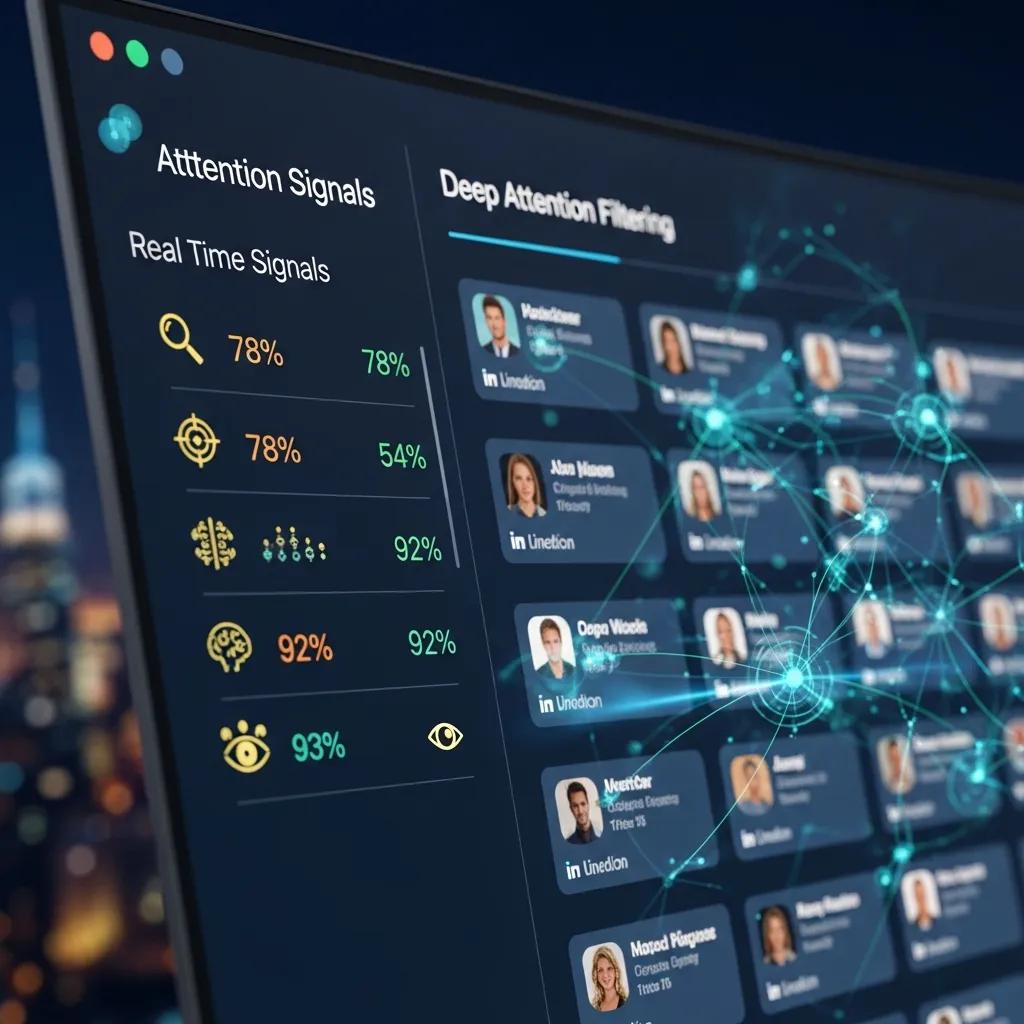
Deep Attention Filtering is Nigel’s proprietary layer that selects the most salient personalisation cues from a prospect’s LinkedIn profile and recent behaviour to create messages that feel human. It scores attention signals—recent posts, bio snippets and activity cues—and maps them to templated message elements that retain genuine relevance. The outcome is outreach that reads bespoke at scale, avoiding the generic language that kills replies. The system balances semantic analysis with behavioural heuristics so messages align with a prospect’s current context.
How Does Deep Attention Filtering Avoid Spam and Increase Engagement?
Deep Attention Filtering reduces spammy outreach by prioritising high-value signals and excluding low-signal prospects from intensive sequences, lowering false positives that harm deliverability and trust. It uses natural language understanding to extract meaningful topics from recent posts and identify role-specific pain points, then weaves those cues into short, specific message lines. By focusing on a handful of high-salience cues instead of generic fields, the system boosts perceived authenticity and prompts more substantive replies—improving both reply quality and downstream qualification.
Why Is Personalised AI Sales Prospecting Important for LinkedIn?
LinkedIn is a professional network where context and credibility matter more than mass outreach; personalised prospecting produces higher-quality conversations and builds trust. Messages that reference a prospect’s recent activity or role show genuine attention and give a clear reason to engage, increasing reply rates and reducing friction to book discovery calls. For B2B teams, platform-specific personalisation shortens sales cycles and reduces wasted SDR time, amplifying ROI when automation is done correctly. Understanding why personalisation works helps design automation that respects context and conversational norms.
Automating discovery and qualification from unstructured web content relies on AI techniques like web crawling and NLP—approaches illustrated by platforms such as Scrapus.
AI for B2B Lead Generation: A Review and Case Study of Scrapus The growth of open web data creates new opportunities for B2B lead generation, but turning unstructured content into actionable leads is challenging. This review covers AI methods—focused crawling, information extraction and analytics—and profiles Scrapus, an AI-driven prospecting platform that combines these techniques. Scrapus crawls the web for company data, extracts and enriches findings with NLP and knowledge graphs, matches results to ideal customer profiles, and produces concise lead summaries using large language models. The article surveys web mining, entity resolution and text summarisation to show how automated lead generation can be implemented end to end.
Who Benefits Most from Nigel’s AI Sales Prospecting Tool?
Nigel serves several personas: time-pressed founders, SDR teams that need scale, and agencies that want repeatable client pipelines. For small teams and founders, Nigel supplies a hands-off pipeline that sustains meeting volume without hiring extra reps. For internal sales teams, it supplements SDR capacity and automates low-value tasks so human sellers can focus on closing. Agencies can productise outreach for clients, delivering steady monthly pipelines under reproducible targeting frameworks. The list below highlights persona-specific benefits to help with decision-making.
Nigel adapts across organisations but consistently aims to increase qualified meeting throughput while cutting manual prospecting hours.
Founders & Small Teams: Offloads prospect outreach so owners can concentrate on revenue and product.
SDR Teams: Automates sourcing and initial qualification to boost rep efficiency.
Agencies: Scales repeatable outreach across client accounts with standardised reporting.
These persona benefits show practical ways Nigel plugs into existing workflows—from hands-off automation to collaborative SDR handoffs that preserve human oversight and relationship management.
How Do Business Owners and Sales Teams Use Nigel for Lead Generation?
Business owners and sales teams typically use Nigel to create a consistent cadence of discovery meetings while keeping in-house expertise for later-stage selling. Owners define target criteria and review early campaign metrics, then let the system run staged outreach while salespeople handle booked demos or negotiations. Sales teams push Nigel’s scoring outputs into their CRM so high-scoring conversations automatically become scheduled discovery meetings or SDR notifications. Over weeks, this converts manual research time into engaged conversations, enabling faster iteration on messaging and segmentation.
What Advantages Does Nigel Offer Marketing Agencies?
Agencies can productise LinkedIn outreach as a recurring service by using Nigel to deliver predictable meeting volumes across multiple clients. Reusable templates, attention-filtered personalisation and centralised scoring allow agencies to scale targeting while keeping distinct messaging per client, improving gross margins versus manual outreach. Standardised reporting on booked meetings and conversion rates helps agencies show pipeline impact and tune campaigns across accounts. That repeatability reduces labour variability and supports performance-based client packages.
How Does Nigel Compare to Manual Prospecting and Other AI Sales Tools?
Compared with manual prospecting, Nigel reduces hours spent on research, initial outreach and follow-up while increasing consistency and scale; versus general-purpose AI chatbots, Nigel is tuned for LinkedIn with attention filtering and booking automation that improve lead quality. The main comparison points are cost, time investment and qualified meetings delivered per month; below we outline the ROI case so teams can weigh setup and subscription costs against hiring or outsourcing alternatives.
What Are the Cost and ROI Benefits of Using Nigel?
Nigel’s pricing begins with a one-time setup fee followed by a monthly subscription—specifically a setup fee of £497 and a recurring cost of £497 per month—which should be compared to the ongoing expense of hiring or contracting manual outreach. When you calculate ROI, include hours saved on sourcing and follow-up, increased discovery meeting volume, and the value of faster pipeline throughput; automated bookings and improved lead quality often produce a short break-even timeline for growing B2B sellers. The simple pricing makes it easy to compare against manual alternatives.
Conclusion
Nigel helps B2B sales teams automate LinkedIn prospecting so they maintain a steady stream of qualified meetings while freeing time to close deals. With features like Deep Attention Filtering and AI lead scoring, teams should expect more relevant outreach, higher engagement and improved conversion—making outreach both scalable and personalised. Adding Nigel to your sales stack can boost productivity and create a more reliable pipeline. Explore the platform to see how Nigel can change the tempo of your lead generation.
