
Transform Your Sales with AI: Lead Generation on LinkedIn
..Complete Guide to AI Sales Representatives: How AI Transforms LinkedIn Lead Generation and Sales Automation

Artificial intelligence sales representatives are software agents that replicate core outbound sales tasks—prospecting, personalized outreach, qualification and scheduling—by analysing LinkedIn signals and conversational replies to surface qualified opportunities. These systems work by combining natural language processing, lead-scoring models and calendar integrations so that outreach feels relevant and scalable while saving hours of manual work and increasing the number of warm meetings booked. Many teams struggle with inconsistent messages, slow follow-ups and limited bandwidth for top-of-funnel outreach; AI sales representatives address these gaps by maintaining cadence, personalizing at scale, and prioritizing replies that indicate buying intent. As a concrete example, Nigel — an AI sales representative for LinkedIn — offers automated personalized outreach (Deep Attention Filtering), AI-driven lead qualification and scoring, 24/7 operation and a pricing model with a setup fee of £497 and a monthly subscription of £497, positioned to fill calendars with warm, qualified buyers while automating top-of-funnel LinkedIn prospecting. This guide explains what an AI sales representative does on LinkedIn, why AI is essential for modern prospecting, how Nigel enables AI-powered LinkedIn prospecting, the mechanics of automated meeting booking and follow-ups, Nigel’s value proposition for businesses, and practical steps to implement AI within your sales strategy.
What is an AI Sales Representative and how does it work on LinkedIn?
An AI sales representative is an automated digital agent that identifies prospects on LinkedIn, crafts context-aware messages, evaluates replies, and books meetings using calendar syncs to accelerate sales pipelines. It works by ingesting LinkedIn profile signals—titles, recent posts, mutual connections and company events—then applying a personalization layer to generate messages that reference meaningful signals, increasing relevance and reply rates. The primary benefit is time reclaimed for sellers while improving consistency and scale in outreach, which in turn raises the number of qualified conversations entering the funnel. Understanding these mechanics clarifies how prospecting, qualification and scheduling become orchestrated processes rather than disconnected tasks, and that orchestration leads directly into the core capabilities discussed next.
Core capabilities: prospecting, qualification, and scheduling

AI sales representatives perform three interlocking capabilities that drive pipeline velocity: prospecting, qualification and scheduling. Prospecting uses LinkedIn filters and activity signals to build targeted lists, applying rules to select accounts and roles that match buyer personas; this reduces wasted outreach while improving match quality. Qualification analyses replies and profile fit with natural language processing and scoring models to convert conversational cues into priority levels, ensuring reps focus on bookable leads. Scheduling integrates with calendars to propose times, confirm meetings and handle reschedules, eliminating back-and-forth and increasing show rates through automated confirmations and reminders.
LinkedIn data utilization for personalized outreach
LinkedIn provides rich, signal-dense data—job titles, recent posts, shared articles, company news and engagement patterns—that AI systems use to craft outreach tailored to context and intent. By detecting recent events like funding announcements or leadership changes, AI can reference timely reasons to connect, which improves authenticity and response likelihood. Privacy and compliance are addressed by limiting data to publicly available profile cues and relying on user-consented messaging, ensuring outreach respects platform policies and professional norms. This signal-driven personalization increases reply rates and naturally leads into why automation is an essential evolution for LinkedIn lead generation.
Research further supports the notion that AI's ability to personalize content significantly boosts engagement on platforms like LinkedIn.
AI-Driven Personalized Content for LinkedIn Engagement
AI systems on Facebook, Instagram, and LinkedIn study user behavior to suggest personalized information that aligns with what each user likes. Specialized neural networks and
The Influence of AI-driven Personalized Content on Social Media Engagement: A Systematic Literature Review, 2025
Why is AI essential for LinkedIn lead generation?
AI becomes essential for LinkedIn lead generation because conventional manual prospecting cannot sustain consistent personalization, follow-ups and scale without significant human resources and time. Manual outreach often results in fragmented sequences, inconsistent messaging and missed follow-ups that reduce conversion; AI addresses these weaknesses by automating cadence, maintaining message quality and scoring leads for follow-up priority. Recent adoption trends show teams that automate routine tasks free sellers to handle higher-value conversations, producing measurable improvements in qualified meetings per week. These capabilities directly reduce spammy or irrelevant outreach while enabling targeted, repeatable processes, which leads into the common pitfalls AI specifically solves.
This section outlines the primary reasons AI is now a necessary component of modern LinkedIn prospecting:
- Personalization at scale: AI applies profile signals to craft tailored messages without manual effort.
- Efficiency and consistency: Automation enforces follow-up cadences and message standards daily.
- Better prioritization: Lead scoring focuses human attention on high-probability opportunities.
These three reasons show why teams that embrace AI can move from ad-hoc outreach to predictable pipeline generation, and the following subsections examine the pain points and advantages in more depth.
Pain points of manual prospecting and risk of spam
Manual prospecting consumes hours each week for individual reps, creating a bottleneck that limits outreach volume and reduces frequency of follow-ups—both of which suppress pipeline growth. Inconsistent messaging from different reps produces brand noise and increases the risk of appearing spammy, which harms deliverability and long-term reputation on LinkedIn. Common scenarios include missed replies, irregular cadences and poorly targeted lists that yield low conversion and wasted effort. Addressing these issues requires automation that standardizes quality while preserving contextual relevance, which paves the way for the AI advantages described next.
AI advantages: personalization, efficiency, and scale
AI improves personalization by mapping LinkedIn signals to message templates and adjusting tone to match recipient context, which increases response rates and engagement. Efficiency gains arise from automating repetitive tasks—list building, follow-up sequences and booking—allowing teams to scale outreach without proportional headcount increases. Finally, 24/7 operation means messages can be sent and processed outside business hours, accelerating response cycles and enabling timely follow-ups. These advantages combine to create scalable, consistent prospecting that elevates qualified meeting counts and supports predictable pipeline growth, and the next section shows how a solution like Nigel operationalizes these benefits.
How Nigel enables AI-powered LinkedIn prospecting
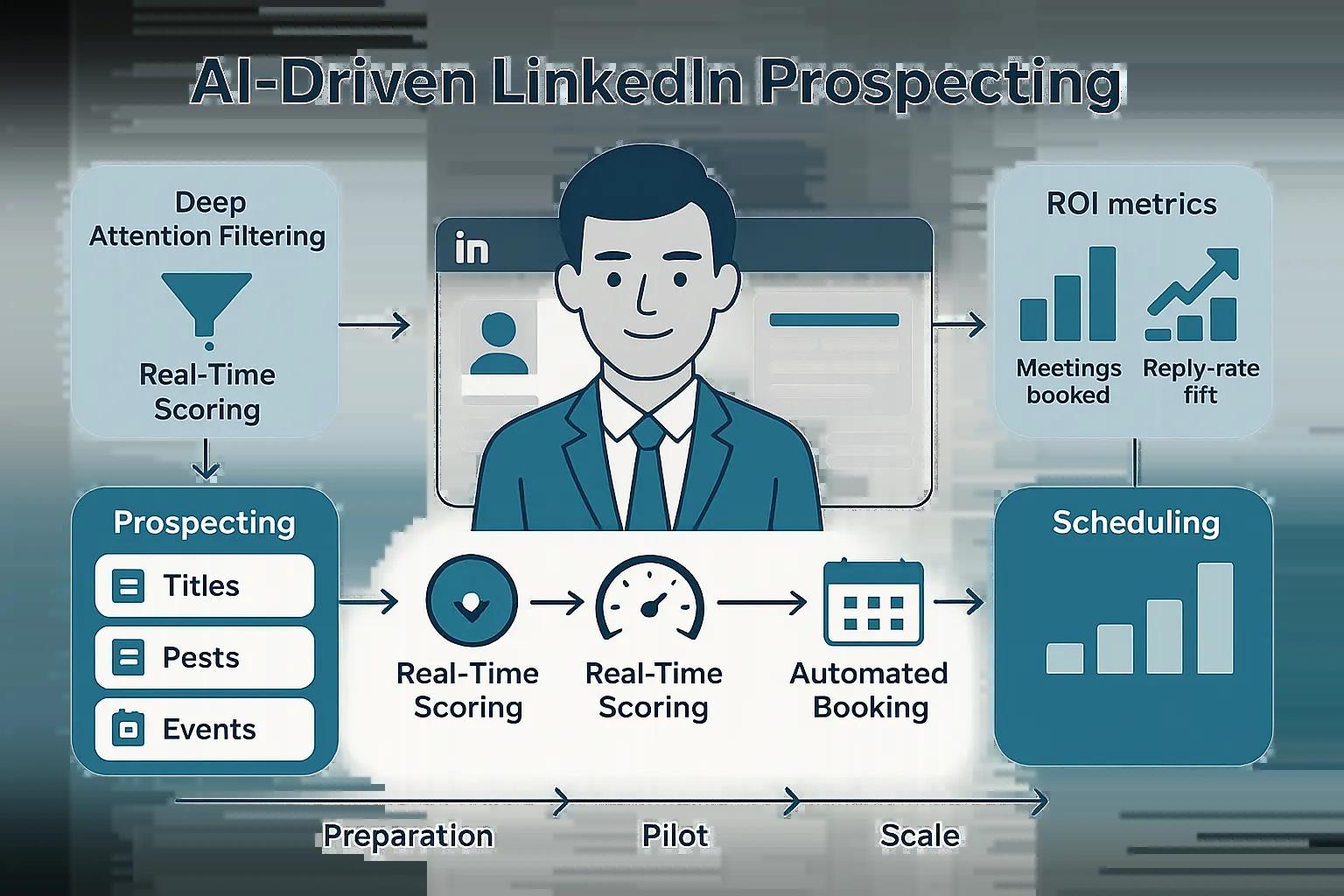
Nigel operationalizes AI-powered LinkedIn prospecting through a set of engineered capabilities: Deep Attention Filtering for message relevance, real-time reply analysis for lead scoring, and automated scheduling to convert interest into confirmed meetings. By combining NLP, patterned personalization and scoring, Nigel reduces noisy outreach while surfacing actionable conversations for sellers. The result is fewer low-value interactions and more calendar time filled with warm, qualified buyers—an outcome that ties directly into ROI and efficiency improvements many teams seek. The following subsections describe those core mechanisms in more practical terms.
Personalised Outreach with Deep Attention Filtering
Deep Attention Filtering is Nigel’s approach to prioritizing the most relevant profile signals—recent posts, role changes, company events and expressed interests—to craft outreach copy that reads like a human-crafted note. This filtering changes a generic template into a targeted message by weighting attention on the highest-impact cues, producing subject lines and openers that reference specific triggers and therefore feel authentic. Example snippets might mention a recent article the prospect shared or congratulate them on a new role, both tactics that increase reply rates. Understanding how attention-derived personalization is generated explains how replies become reliable signals for qualification and scoring.
AI-driven Lead Qualification and Real-Time Scoring
Nigel analyses incoming replies and profile fit to assign a real-time score that guides prioritization, routing top-scoring leads into immediate booking flows and lower scores into nurture sequences. The following table illustrates a sample lead-scoring model showing signal types, example criteria/weight and the score contribution to a composite lead score.
Intro: This table shows typical scoring signals Nigel would use to quantify lead quality and prioritize follow-ups.
| Signal | Criteria / Weight | Score Contribution |
|---|---|---|
| Profile Fit | Job title match to ICP (weight: 40%) | 0–40 points |
| Reply Intent | Explicit interest or question (weight: 35%) | 0–35 points |
| Buying Signals | Mentions budget/timeline (weight: 15%) | 0–15 points |
| Engagement | Response speed and length (weight: 10%) | 0–10 points |
This sample scorecard makes scoring transparent and explains how different signals combine to produce a single prioritised score that determines whether a lead is routed to immediate booking, further qualification, or nurture sequences.
Automated meeting booking, follow-ups, and sales funnel automation
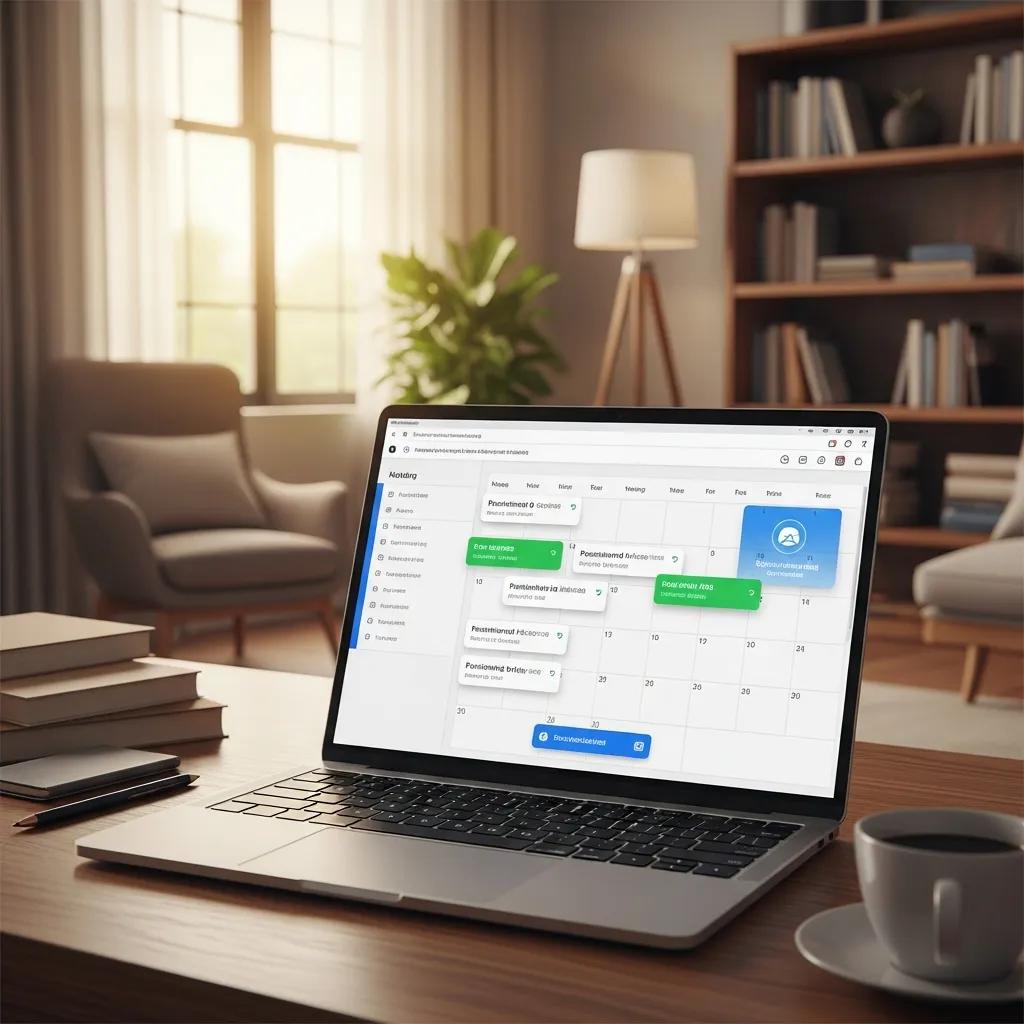
End-to-end automation moves a qualified conversation from initial outreach to a scheduled meeting and into CRM pipeline stages while preserving context and reducing human handoffs. Automated meeting booking removes scheduling friction by suggesting times, verifying availability via calendar syncs, and sending confirmations and reminders to improve show rates. Follow-ups are orchestrated using trigger-based sequences that advance leads through funnel stages based on reply semantics and engagement. Together, these automation layers create a seamless funnel that increases conversion from initial contact to opportunity, and the next subsections detail scheduling mechanics and nurture momentum.
Automated scheduling and calendar management
Automated scheduling maps prospect availability to seller calendars by checking free/busy windows and proposing optimal times, supporting both proposed-time workflows and instant-book options where appropriate. Common integrations include calendar platforms and CRM systems to ensure meetings are logged and context is preserved, with fallbacks for rescheduling and time-zone normalization. This reduces the typical multi-email scheduling exchange to a single confirmation, lowering friction and improving meeting acceptance rates. By keeping calendar data synchronized and handling reschedules automatically, the system maintains pipeline accuracy and seller focus on high-value engagements.
The inherent complexities of manual meeting coordination highlight the critical need for such automated scheduling solutions.
Automated Meeting Scheduling Systems for Efficiency
AbstractFinding a suitable time for a meeting between multiple people is a common practical problem today. The meeting scheduling process involves sharing information about one's availability and negotiating possible meeting times. The process can often be arduous and time-consuming. There are many software applications that simplify the scheduling process but they often still require a lot of manual effort to use or cannot be used to schedule meetings across different organizations.
Meeting scheduling assistant; Automatic scheduling between heterogeneous calendar systems, 2012
Intro: Typical scheduling features reduce friction in booking and improve the pipeline hygiene that teams need.
- Calendar syncs ensure availability is accurate across platforms.
- Proposed-time workflows allow prospects to select preferred slots.
- Automated reminders and rescheduling rules increase meeting show rates.
Summary: These scheduling features improve the probability that a qualified lead converts into a live conversation and naturally feed into automated follow-up policies.
Maintaining momentum with follow-ups and pipeline progression
Automated follow-ups use predefined cadences and trigger rules that escalate outreach when prospects engage or transition leads into nurturing when responses are low-priority. A typical follow-up cadence blends short check-ins with value-based messages and uses reply analysis to determine whether to accelerate booking or switch to a long-term nurture track.
Pipeline progression rules advance leads through CRM stages when specific events occur—confirmed meeting, demo completed or budget disclosed—ensuring accurate forecasting and easier handoffs to account teams. Measuring nurture effectiveness relies on conversion metrics such as reply-to-booking rate, meetings per outreach sequence and pipeline velocity, which inform cadence optimization.
This orchestration of scheduling and follow-ups supports a consistent pipeline and leads into the concrete business value Nigel provides.
The value proposition of Nigel for businesses
Nigel positions itself as a solution to automate top-of-funnel LinkedIn prospecting, focusing on personalized outreach, AI-driven qualification and automated booking to fill calendars with warm, qualified buyers. For businesses evaluating AI sales representatives, Nigel’s core capabilities map directly to measurable outcomes like increased meetings booked per week, response-rate improvement and reduced human-hours on routine tasks. The following table compares capabilities to typical outcomes to illustrate the business case. AI LinkedIn Sales Representative
Intro: The table below pairs Nigel’s capabilities with measurable outcomes companies can expect when they adopt the platform.
| Capability | Attribute | Outcome / Metric |
|---|---|---|
| Personalized Outreach | Deep Attention Filtering | Higher reply rates; % lift depends on baseline |
| Lead Qualification | Real-time scoring | Faster prioritization; reduced wasted follow-ups |
| Meeting Automation | Calendar sync + booking | More meetings booked per week; fewer scheduling cycles |
Summary: Mapping features to outcomes makes it clearer how Nigel translates technical capabilities into commercial impact, which is useful for ROI conversations and target-setting.
Nigel's core capabilities and benefits
Nigel combines three core capabilities—personalized outreach, automated qualification and meeting booking—into a continuous workflow that turns LinkedIn activity into scheduled conversations. Personalized outreach increases signal relevance and response likelihood by referencing profile cues and recent activity, while AI-driven scoring ensures human sellers focus on the highest-probability leads. Automated booking removes scheduling friction and logs meetings directly in CRM, improving hygiene and time-to-first-meeting. These combined benefits typically translate into higher meetings-per-outreach and meaningful time savings for teams, forming a clear business case for adoption.
Who benefits: Founders, Sales Teams, Agencies
- Founders benefit from time and cost savings by automating routine outreach, letting them focus on strategy and closing; expected outcomes include fewer hours spent on prospecting and faster lead qualification.
- Sales teams gain pipeline consistency and higher-quality meetings by shifting repetitive tasks to AI and prioritizing human effort on live conversations; measurable metrics include meetings booked per rep and reply-to-booking ratios.
- Agencies scale client outreach without proportionally increasing staff by deploying automated multi-client sequences and standardized qualification; outcomes include more client accounts served and predictable performance across campaigns.
Implementing AI in your sales strategy and future trends
Adopting an AI sales representative requires preparation, piloting and iteration—starting with data and audience definition, moving through a small-scale pilot and expanding with integrations and governance. Best practices include defining an ideal customer profile, establishing KPIs for reply and booking rates, and ensuring CRM/calendar integrations are tested before full rollout. Governance and guardrails—message templates, escalation rules and compliance checks—keep automation aligned with brand guidelines and platform policies. The following subsections provide a practical checklist and suggest next steps, including an option to explore Nigel as part of your evaluation.
Step-by-step integration and best practices
A phased approach reduces risk and accelerates learning when integrating an AI sales representative.
- Preparation: Define target audiences, prepare protected message templates and ensure CRM fields match expected data from LinkedIn.
- Pilot: Run a controlled campaign with a small segment, track reply-to-booking metrics and iterate on message filters.
- Scale: Add more segments, integrate calendars and CRM fully, and set governance rules for escalation and human takeover.
Intro: The numbered checklist above outlines a typical rollout timeline and the sequence of tasks that minimize disruption.
Summary: Following this staged approach ensures teams measure real impact quickly and avoid common pitfalls such as over-automation without quality checks.
Intro to table: The following integration checklist table shows the entity, required step and estimated time/complexity for common integration points.
| Integration Point | Requirement / Step | Time / Complexity |
|---|---|---|
| CRM integration | Map fields, automate pipeline stages | 1–2 days / Medium |
| Calendar sync | Authorize calendar, test booking flows | 1 day / Low |
| LinkedIn targeting | Define filters and seed lists | 2–3 days / Low–Medium |
| Pilot campaign | Run 2-week test and measure KPIs | 2 weeks / Medium |
Summary: This checklist gives a practical view of effort and helps teams plan resources and timelines for a smooth deployment.
Industry trends, case studies, and next steps with Nigel
Recent industry trends through 2025 show rapid AI adoption in B2B prospecting, rising expectations for personalization and growing demand for automation that preserves human oversight. Early case outcomes commonly reported include higher reply rates, quicker lead qualification and more repeatable pipeline generation when teams adopt AI-driven approaches. For teams considering a specific solution, Nigel represents a focused option that combines Deep Attention Filtering, real-time scoring and automated booking; exploring a pilot can reveal expected uplift and help set realistic KPIs. If you want to evaluate AI-assisted LinkedIn prospecting, consider running a controlled pilot that measures reply-to-booking rate, meetings per outreach sequence and hours saved.
Indeed, the broader impact of AI on B2B sales processes is a significant trend reshaping traditional sales methodologies.
AI's Transformative Impact on B2B Sales Processes
The megatrend of digitalization profoundly changes the business-to-business (B2B) sales environment. In particular artificial intelligence (AI) can change established sales routines and partially substitute sales tasks. Thus, this paper presents an overview of sales processes in the literature and a description of AI. Afterward, we show how AI can be applied in the different sales process phases and describe each identified use case in detail. The results show that AI can be applied in every sales process step, and profiles generated by AI are the key to the successful application of AI in B2B sales.
Artificial intelligence in B2B sales: Impact on the sales process, H Fischer, 2022
Final transition: These next steps and measurable KPIs are essential for determining whether an AI sales representative delivers the expected ROI and for refining the process as adoption scales.
About the Author
Adam Baetu is the founder of Funnel Automation and the creator of Nigel, an AI-powered LinkedIn sales assistant used by B2B founders and service businesses to generate and qualify leads automatically. With over a decade of hands-on experience in lead generation, outbound sales, and marketing automation, Adam specialises in building practical AI systems that drive real conversations, booked calls, and measurable pipeline growth.
Frequently Asked Questions
1. How does AI improve the quality of leads generated on LinkedIn?
AI enhances lead quality on LinkedIn by leveraging data-driven insights to identify and engage with prospects who exhibit strong buying signals. By analysing profile information, recent activities, and engagement patterns, AI systems can craft personalized outreach that resonates with potential clients. This targeted approach not only increases the likelihood of responses but also ensures that sales teams focus their efforts on leads that are more likely to convert, ultimately improving the overall efficiency of the sales process.
2. What are the potential challenges of implementing AI sales representatives?
Implementing AI sales representatives can present several challenges, including data privacy concerns, integration with existing systems, and the need for ongoing training and adjustments. Companies must ensure compliance with data protection regulations while also managing the technical aspects of integrating AI tools with their CRM and calendar systems. Additionally, teams may need to adapt their sales strategies and workflows to fully leverage AI capabilities, which can require a cultural shift within the organisation.
3. Can AI sales representatives replace human sales teams entirely?
While AI sales representatives can significantly enhance efficiency and productivity, they are not designed to replace human sales teams entirely. Instead, they serve as valuable tools that automate repetitive tasks, allowing human sellers to focus on high-value interactions and relationship-building. The combination of AI's data processing capabilities and human intuition creates a more effective sales strategy, where AI handles the initial outreach and qualification, while humans engage in deeper conversations with qualified leads. AI sales machine
4. How can businesses measure the success of AI in their sales processes?
Businesses can measure the success of AI in their sales processes through key performance indicators (KPIs) such as the number of meetings booked, response rates, and conversion rates from leads to customers. Tracking metrics like the reply-to-booking ratio and the time taken to qualify leads can provide insights into the effectiveness of AI tools. Additionally, comparing these metrics before and after AI implementation can help quantify the impact of AI on overall sales performance and efficiency.
5. What types of businesses benefit most from using AI sales representatives?
AI sales representatives are particularly beneficial for businesses with high-volume outreach needs, such as B2B companies, sales agencies, and startups looking to scale quickly. These organisations often face challenges in managing large prospect lists and maintaining consistent follow-up cadences. By automating these processes, AI can help them achieve greater efficiency, improve lead qualification, and ultimately increase the number of qualified meetings, making it easier to grow their customer base.
6. How does AI ensure compliance with LinkedIn's policies during outreach?
AI systems ensure compliance with LinkedIn's policies by using publicly available profile data and adhering to user-consented messaging practices. This means that AI sales representatives only engage with prospects based on information that users have chosen to share, thus respecting privacy and platform guidelines. Additionally, businesses can implement governance measures, such as message templates and escalation rules, to maintain compliance and align outreach efforts with professional norms.
7. What future trends should businesses watch for in AI sales technology?
Future trends in AI sales technology include increased personalization through advanced machine learning algorithms, greater integration with CRM systems, and enhanced analytics capabilities for measuring outreach effectiveness. As AI continues to evolve, businesses can expect more sophisticated tools that not only automate tasks but also provide deeper insights into customer behaviour and preferences. Staying informed about these trends will help companies leverage AI effectively to maintain a competitive edge in their sales strategies.
