
Unleashing GEO: How AI Recommendations Transform Marketing
Unlocking AI Search Optimization

Generative Engine Optimization (GEO) is the practice of designing content and technical signals specifically to increase the likelihood that generative AI systems and answer engines will select, synthesize, and cite your content. GEO matters because modern search behavior is shifting from ranking pages toward surfaced answers and AI-driven overviews, and content optimized for LLM citation captures zero-click and conversational traffic that traditional SEO does not. This guide explains GEO’s origins, core mechanisms, practical tactics, and measurement approaches so publishers, product teams, and SEO practitioners can adapt workflows for 2025 and beyond. You will learn how generative models ingest and prioritize sources, which content structures they prefer, how to demonstrate E-E-A-T for machine trust, which schema types most reliably surface facts, and how to monitor AI citation performance. The article proceeds through clear how-to sections that map theory to implementation and includes checklists, EAV tables, and practical monitoring recommendations to make GEO actionable.
What is Generative Engine Optimization and Why Does It Matter?
Generative Engine Optimization (GEO) is a targeted subset of Search Engine Optimization focused on improving visibility inside generative AI outputs, such as AI Overviews and answer engines, by optimizing for citation, snippet inclusion, and trusted synthesis. GEO works by aligning content to entity-first semantics, concise answer blocks, structured metadata, and demonstrable provenance so that retrieval-then-generation pipelines can both find and trust your source. The practical result is increased presence in zero-click answers, higher branded mention frequency in AI responses, and new attribution opportunities that drive referral traffic and conversions. Because LLM-driven answers increasingly shape discovery, publishers who optimize for AI citation gain early access to high-intent audiences that may never visit SERPs directly. The next sections break down how GEO differs from traditional SEO and the core principles that guide successful implementation.
Lionizing the differences between citation-focused success and ranking-focused success clarifies how GEO shifts tactics away from keyword density toward semantic clarity and trust signals. This contrast prepares us to list the core GEO principles that govern content and technical decisions for AI-driven discovery.
How Does GEO Differ from Traditional SEO?
GEO differs from traditional SEO primarily in its success metrics, signal priorities, and content form factor, with a stronger emphasis on being cited rather than simply ranked. Traditional SEO optimizes for SERP rankings using backlinks, keyword targeting, and page-level authority, while GEO optimizes for retrieval signals, entity clarity, and snippet-ready answer blocks that LLMs can surface directly. In practice, GEO favors concise, well-sourced definitions and structured facts, whereas SEO favors comprehensive topical depth and internal linking for rank. For example, a GEO-focused page will include a short TL;DR answer and explicit entity definitions to increase citation probability, while a traditional SEO page might prioritize long-form pillar content to capture multiple queries. Understanding this difference helps teams reprioritize content templates and measurement toward AI citation frequency and entity mention volume.
These tactical contrasts naturally lead into the foundational principles and goals that designers should apply when building GEO-aligned content.
What Are the Core Principles and Goals of GEO?
GEO relies on a compact set of principles that collectively improve machine comprehension, citation likelihood, and trustworthiness for LLMs and answer engines. First, semantic clarity ensures each entity and concept is defined unambiguously so retrieval systems map queries to the correct source. Second, entity-first content and structured definitions enable knowledge-graph-ready consumption and precise quoting by answer engines. Third, machine-readable metadata and schema markup provide explicit signals for fact extraction and provenance. Fourth, demonstrable E-E-A-T — including first-person experience and transparent authorship — increases a source’s citation weight. Fifth, content freshness and clear update cadence maintain recency signals important to many LLMs. Together these principles guide content formats and editorial workflows that prioritize being cited over simply ranking, and the next section explains how being seen by LLMs use these signals during retrieval and synthesis.
Each of these principles suggests specific implementation steps, beginning with how generative AI and answer engines ingest and prioritize content in modern search pipelines.
How Do Generative AI and Answer Engines Work in Search?
Generative AI and answer engines operate using a retrieval-then-generation pipeline: they first collect candidate documents, then retrieve relevant passages, synthesize answers via an LLM, and finally decide whether to cite sources. This pipeline prefers sources that are semantically indexed, have clear entity definitions, and include structured facts or metadata that make extraction reliable, so improving those attributes raises citation probability. The practical implication is that content creators need to supply both machine-readable facts and concise, well-sourced answer snippets to be used in synthesis. Below is a compact component breakdown that explains which systems do what and how that impacts content preparation.
| Component | Role in LLM/Answer Engine | Practical Implication |
|---|---|---|
| Crawler / Indexer | Collects and stores content and metadata for retrieval | Ensure pages are crawlable, have sitemaps, and expose structured metadata |
| Retrieval Layer (RAG/Vector DB) | Selects candidate passages by semantic similarity | Provide clear definitions and short answer blocks to improve retrieval score |
| Large Language Model (LLM) | Synthesizes human-readable answer from retrieved passages | Make source passages concise and self-contained for accurate generation |
| Citation Module | Decides when and how to attribute source in output | Surface explicit provenance, dates, and author info to increase citation likelihood |
This component view highlights why retrieval quality and source clarity matter: retrieval selects the inputs, the LLM generates the answer, and the citation module determines whether the output will cite. Understanding this flow makes it easier to design content that moves from discovery to attribution.
What Role Do Large Language Models Play in AI Search?
Large Language Models (LLMs) function as the generative core that turns retrieved passages into fluent answers, and their behavior depends on both training data and the retrieval context provided at query time. During search, LLMs accept retrieval results—often semantically ranked snippets or embeddings—and synthesize them into coherent responses while balancing fluency, factuality, and brevity. Because LLMs favor clear, unambiguous source text, concise sentences, factual lists, and well-labeled entities improve the chance of accurate synthesis and faithful citation. LLMs also interpolate across sources when gaps exist, so explicit provenance and precise facts reduce hallucination risk and make generated answers more likely to include direct citations. Recognizing the LLM’s role emphasizes why content teams must craft machine-friendly passages rather than rely solely on traditional long-form narrative.
Exploring citation behavior next clarifies how answer engines choose and format attributions when they include sources.
How Do AI Overviews and Answer Engines Select and Cite Content?
AI Overviews and answer engines choose content to cite by weighing authority signals (E-E-A-T), recency, clarity of facts, and availability of structured metadata, and they format citations in platform-dependent ways. Platforms may prefer numbered source lists, inline parenthetical attributions, or hyperlinked references in companion UI; regardless, clarity of the original passage and explicit date/author metadata increase the chance of selection. Common selection signals in order typically include demonstrable expertise and provenance, succinct factual statements, structured data presence, and recent update timestamps. To increase citation probability, authors should present short, self-contained facts with explicit dates and author information, and use schema types that expose entity relationships and defined terms.
This signal hierarchy leads directly into practical, prioritized strategies for making content more likely to be chosen and cited by generative systems.
What Are Effective Strategies for Optimizing Content for AI Citation?
Optimizing for AI citation requires a checklist of tactical steps that prioritize entity clarity, concise answers, and trust signals; apply these steps to priority pages first and scale via templates. Begin by placing a brief, direct answer or TL;DR at the top of each page, followed by a short definition of the primary entities. Combine that with structured data exposing author, publisher, dateModified, and DefinedTerm entries for key concepts. Finally, include primary research, case studies, or first-person experience where possible to satisfy the Experience and Expertise aspects of E-E-A-T.
Below is an action-oriented checklist to follow when preparing content for AI Overviews and answer engines.
- Lead with a clear answer: Put a one- or two-sentence answer at the top of the page for quick extraction.
- Define entities explicitly: Use short DefinedTerm sections to describe core concepts in plain terms.
- Add machine-readable metadata: Include JSON-LD for author, dateModified, and content type.
- Cite primary sources: Embed references and links to original studies or data to increase trust.
- Maintain freshness: Update dateModified and refresh facts on a scheduled cadence.
These prioritized steps form a repeatable pattern for GEO-ready pages and naturally map to E-E-A-T practices summarized in the table below.
This table compares E-E-A-T signals to concrete content actions publishers can take to improve AI trustworthiness and citation likelihood.
| Signal | Practical Content Action | Example Outcome |
|---|---|---|
| Experience | Add first-person case studies or original data | Demonstrable use-cases that LLMs can cite as provenance |
| Expertise | Publish author bios with credentials and topical history | Higher authority weight in citation decisions |
| Authoritativeness | Link to or reference primary literature and datasets | Increases platform confidence for attribution |
| Trustworthiness | Use transparent sourcing, corrections, and FactCheck schema | Reduces hallucination and supports explicit citations |
Mapping signals to actions helps editorial teams convert abstract E-E-A-T into reproducible content tasks that improve citation potential. The next section shows how to structure and update that content to maximize use by answer engines.
How to Demonstrate E-E-A-T for AI Trustworthiness?
Demonstrating E-E-A-T for AI requires explicit, machine-friendly provenance and human-facing credentials to create a coherent trust signal both for algorithms and readers. Start by publishing detailed author bios with verifiable expertise, include first-hand data or case studies that show experience, and reference reputable third-party sources to establish authoritativeness. Use structured data to encode authorship, publisher, and content type so the citation module can read provenance without parsing the narrative. Transparency about updates, revisions, and error corrections contributes to trustworthiness and can be surfaced by answer engines as reliability signals.
These content practices convert abstract trust concepts into specific artifacts that answer engines prefer, which then demands regular updates to maintain signal freshness.
How to Structure and Update Content for AI Overviews and Zero-Click Searches?
Structure content to be easily parsed by retrieval systems: begin with an explicit TL;DR answer, follow with short definitional paragraphs or bullet lists, and include structured data for entities and facts. Use clear H2/H3 headings that map to likely user intents and keep micro-paragraphs under three sentences so extraction tools can isolate facts. Implement an update workflow with a visible dateModified and a quarterly review cadence for evergreen topics and a more frequent cadence for time-sensitive facts. These layout and update patterns increase the chance that answer engines will both extract usable passages and prefer your page when compiling overviews.
Indeed, effective content optimization for AI involves not just structure but also leveraging AI itself to refine content strategies.
AI Content Optimization for Online Media
AI can suggest new content ideas for online media platforms to publish. Content Optimization: AI can also help to optimize content for
AI Revolution in Online Media: Transforming Content Creation, Distribution, and Consumption, 2024
This editorial structure directly informs the schema and technical steps outlined next, ensuring that machine-readable signals are present and accessible.
How to Implement Structured Data and Technical SEO for GEO?
Structured data and robust technical SEO are foundational to GEO because they convert human content into machine-readable facts that retrieval and citation systems can rely on. Use Article, FAQPage, HowTo, FactCheck, and DefinedTerm schema types to expose answers and entity definitions clearly, and include author and publisher markup for provenance. Ensure your site is crawlable by server-side rendering or pre-rendered snapshots, maintain clean sitemaps and canonical tags, and avoid blocking critical resources in robots.txt. Below is a practical schema mapping table that shows which types to apply for common content pieces and why they matter for AI comprehension.
This table lists schema types and example use cases to guide implementation.
| Content Piece | Schema Type | Use Case / Example |
|---|---|---|
| Short explanatory pages | Article | Expose headline, author, datePublished, and dateModified for citation |
| Q&A or support pages | FAQPage | Provide structured question-answer pairs that are easy for LLMs to extract |
| Procedural guides | HowTo | Break steps into ordered items with concise action statements |
| Claims and corrections | FactCheck | Surface verdicts and cited sources for debunking and provenance |
| Core definitions | DefinedTerm | Create canonical entity definitions for knowledge graph consumption |
These mappings make it straightforward for developers and content engineers to prioritize which schema to add first, depending on page type and GEO goals.
Which Schema.org Markup Types Enhance AI Comprehension?
Selecting the right schema types helps generative systems parse your content into discrete, attributable facts and entity definitions that they can cite with confidence. Article schema is foundational for any long-form piece, exposing author, date, and headline metadata. FAQPage and HowTo schemas convert common Q&A and procedural content into easily extractable units that answer engines favor for snippet use. FactCheck schema is useful when content evaluates claims, increasing the chance that a platform will surface your verification as a trusted source. DefinedTerm is particularly valuable in GEO because it establishes canonical entity definitions that map directly to knowledge graph concepts and reduce ambiguity during retrieval.
Applying these schema types and encoding author/publisher metadata increases the structural signals that retrieval layers and citation modules use to trust and attribute content.
How to Ensure Technical Accessibility for AI Crawlers?
Technical accessibility for AI crawlers requires consistent crawlability, minimal reliance on client-side rendering for core facts, and explicit exposure of structured resources like JSON-LD and sitemaps. Ensure server-side rendering or pre-rendered HTML snapshots for content that must be indexed, keep critical pages linked in sitemaps, and validate that robots.txt and canonical tags do not block or misdirect crawler access. Provide clean semantic content with descriptive alt text and avoid burying facts inside heavy interactive components that prevent extraction. Running periodic accessibility audits with rendering checks and structured-data validators helps catch issues before they reduce citation potential.
These technical measures remove barriers between your content and the retrieval pipeline, making it more likely your content will be fetched, indexed, and used in synthesized answers.
How to Measure and Monitor GEO Performance Effectively?
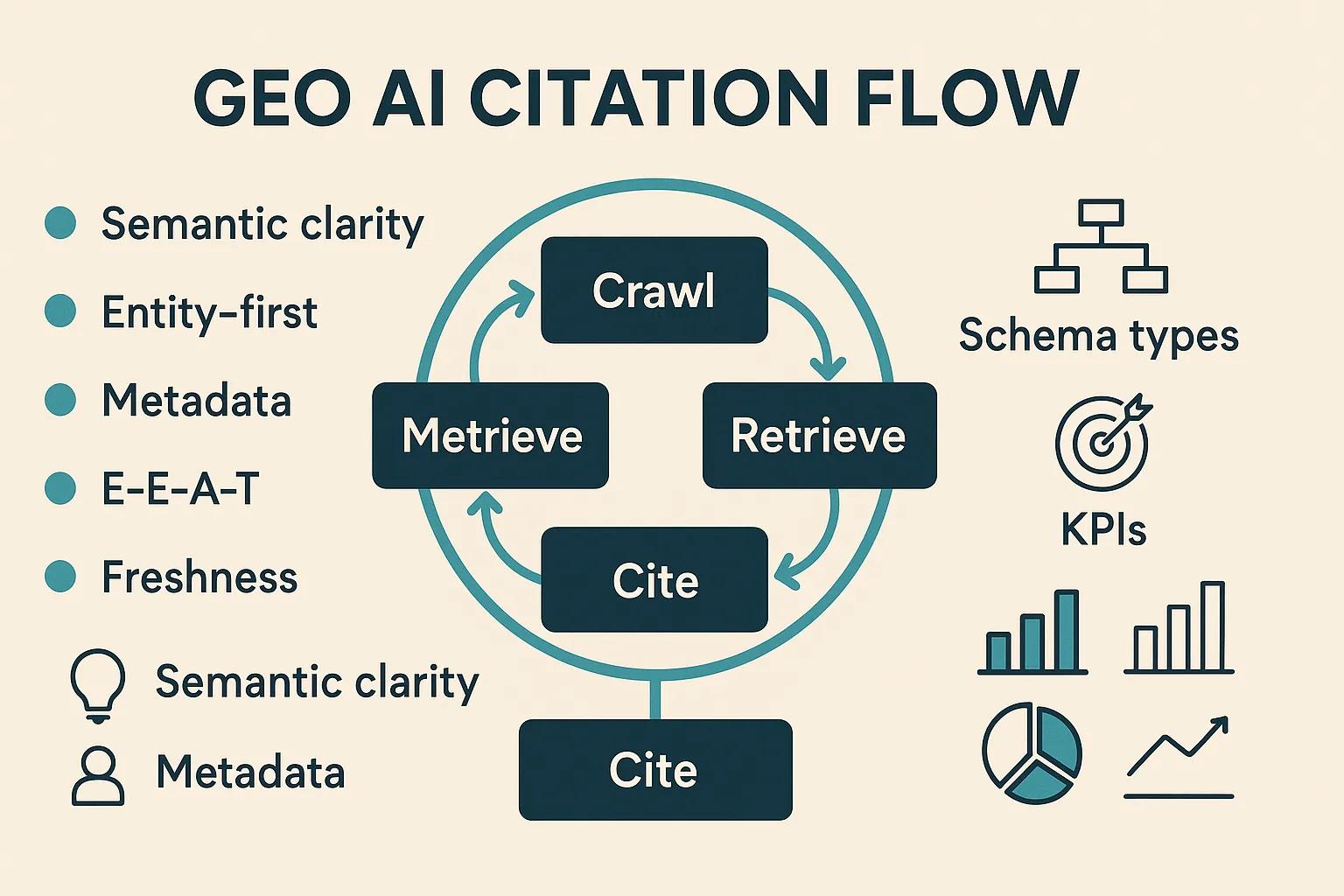
Measuring GEO requires new KPIs beyond traditional ranking metrics: track AI citation frequency, AI-driven impressions, brand mention volume in AI outputs, and the conversion impact of traffic that originates from AI surfaces. Combine automated monitoring tools with manual sampling of major platforms to quantify when your pages are cited in AI Overviews and conversational responses. Establish baseline targets—such as month-over-month growth in AI citation rate—and include GEO metrics in regular reporting to ensure teams respond to shifts in platform behavior. The list below suggests primary metrics to include in a GEO dashboard and how to interpret them.
The following list outlines key GEO KPIs for a monitoring dashboard.
- AI citation frequency: The number of times your pages are cited in AI-generated answers during a reporting period.
- AI-overview impressions: Estimated impressions when content appears inside a platform’s overview or answer panel.
- Brand mention volume: Count and sentiment of brand mentions inside AI responses and summaries.
- Engagement from AI-origin traffic: Click-throughs, time on page, and conversion rates for visits that originated from AI summaries.
Tracking these KPIs helps teams correlate GEO activities with business outcomes and prioritize pages for optimization.
What Key Performance Indicators Track AI Citation and Visibility?
Each GEO KPI maps to specific measurement methods: AI citation frequency can be tracked via platform APIs or manual sampling, AI-overview impressions may be estimated through impression logs or third-party tools, and brand mention volume can be monitored via text-mining of AI outputs. Engagement metrics require tagging and attribution mechanisms that can detect traffic sources originating from AI-driven surfaces or query patterns. Suggested benchmarks depend on niche and traffic volume, but a practical target is measurable month-over-month increase in citation frequency combined with maintained or improved conversion rates for AI-origin visits.
These KPI definitions form the basis for tool selection and monitoring cadence, which we cover next.
Which Tools and Processes Support Continuous GEO Monitoring?
Continuous GEO monitoring blends automated tooling and manual verification: use semantic search and AI visibility tools to surface likely citations, configure search-console-like logging to capture AI-referral parameters, and perform weekly manual checks on top-priority queries across major platforms. Implement a monitoring cadence that includes daily alerts for sudden citation drops, weekly sampling of AI outputs, and quarterly content audits to refresh facts and metadata. Establish SOPs for rapid content updates when platform behavior or LLM evidence indicates shifting signal priorities.
A disciplined monitoring process ensures that GEO activities remain responsive to platform changes and maintain citation health for high-value assets.
What is the Future of Generative Engine Optimization in AI Search?
The future of GEO will be shaped by continued LLM traffic growth, platform-specific citation behaviors, and an increased premium on real-time facts and provenance; successful practitioners will adapt by integrating GEO into core editorial and engineering workflows. Expect platform fragmentation—different answer engines will prefer different signal mixes—so publishers should build modular content templates, robust schema adoption, and monitoring that covers multiple AI providers. Ethical practices and transparency around sources and corrections will become competitive differentiators as audiences and platforms demand accountability. The remainder of this section outlines emerging trends and a practical roadmap for teams to operationalize GEO in the near term.
These anticipated trends suggest concrete tactical shifts, which we enumerate below to help teams prepare.
What Emerging Trends Will Shape GEO and AI Search Evolution?
Several trends will shape GEO in the short to medium term: rapid growth in LLM-driven discovery will increase zero-click volume, platform-specific citation heuristics will require multi-platform optimization, real-time and high-recency data will be prioritized for certain queries, and standards for provenance and verifiable facts will tighten. Each trend implies different priorities: publishers focused on evergreen authority should double down on DefinedTerm and FactCheck markup, while news and data providers must optimize update pipelines and streaming metadata. Additionally, specialized verticals may see dedicated answer engines that favor domain-specific signals, increasing the need for tailored GEO approaches.
These trend insights inform a practical roadmap for integrating GEO into existing workflows, which follows next.
How to Adapt SEO Workflows to Integrate GEO Strategies?
To integrate GEO into standard SEO workflows, assign ownership for AI citation goals, add E-E-A-T checks to content QA, expand schema adoption as part of publishing pipelines, and include GEO KPIs in regular reporting. Train editorial teams to write answer-first TL;DRs and create DefinedTerm sections for canonical entities, while engineering teams should automate JSON-LD injection and dateModified updates. Establish a quarterly audit cadence that reviews citation frequency and refreshes top-priority pages, and include cross-functional stakeholders—product, legal, and data—to maintain provenance and ethical practices. A short roadmap: pilot GEO on high-intent pages, measure citation lift, scale templates, and institutionalize monitoring and update workflows.
Integrating AI into content workflows extends beyond optimization to encompass the entire content marketing lifecycle, from topic selection to summarization.
AI-Driven Content Marketing & Summarization
This paper presents this tool with a focus on each of the innovations in data and AI-driven media analysis to address each key step in the digital content marketing workflow: topic selection, content search and video summarisation.
AI and data-driven media analysis of TV content for optimised digital content marketing, L Nixon, 2024
This operational approach converts GEO strategy into repeatable processes that organizations can scale as AI-driven discovery continues to evolve.
About the Author
Adam Baetu is a UK-based entrepreneur and AI automation specialist with over 13 years’ experience helping businesses improve visibility, lead generation, and conversion through smart systems rather than manual effort. He is the founder of Funnel Automation, where he builds AI-powered solutions that help businesses get found, start conversations, and book qualified calls automatically across search, LinkedIn, and messaging channels.
Adam is also the creator of Nigel, an AI visibility and outreach assistant designed to help businesses show up where modern search is heading — including large language models, generative search, and AI-driven recommendations.
Learn more about Nigel and AI visibility here: 👉 discover.nigel-the-ai.com/nigel-ai-visibility
Frequently Asked Questions
What types of content are best suited for Generative Engine Optimization?
Content that is concise, well-structured, and rich in factual information is best suited for Generative Engine Optimization (GEO). This includes short answer blocks, clear definitions of entities, and structured data that enhances machine readability. Articles, FAQs, and How-To guides that prioritize direct answers and include schema markup are particularly effective. Additionally, content that demonstrates expertise and authority, such as case studies or original research, can significantly improve citation likelihood in AI-generated outputs.
How can I ensure my content remains relevant for AI citation over time?
To keep your content relevant for AI citation, implement a regular update schedule that includes refreshing facts, revising outdated information, and maintaining accurate metadata. Establish a clear dateModified tag to signal recency to AI systems. Additionally, monitor industry trends and emerging topics to adapt your content accordingly. Engaging with user feedback and analytics can also help identify areas for improvement, ensuring your content remains valuable and trustworthy for both users and AI systems.
What role does structured data play in Generative Engine Optimization?
Structured data is crucial for Generative Engine Optimization as it transforms human-readable content into machine-readable formats that AI systems can easily parse and understand. By using schema types like Article, FAQPage, and DefinedTerm, you provide explicit signals about the content's context, authorship, and factual accuracy. This enhances the likelihood of your content being cited in AI-generated answers and improves its visibility in search results, ultimately driving more traffic to your site.
How can I measure the success of my GEO efforts?
Measuring the success of your Generative Engine Optimization efforts involves tracking specific key performance indicators (KPIs) such as AI citation frequency, impressions from AI-generated overviews, and engagement metrics from AI-origin traffic. Utilize tools that monitor these metrics and establish baseline targets for growth. Regularly review and analyze this data to assess the effectiveness of your strategies and make informed adjustments to improve your content's performance in AI-driven environments.
What are the common pitfalls to avoid when implementing GEO?
Common pitfalls in implementing Generative Engine Optimization include neglecting the importance of structured data, failing to update content regularly, and not prioritizing entity clarity. Additionally, overloading content with jargon or lengthy narratives can hinder AI systems from extracting concise information. It's also crucial to avoid ignoring user intent; content should be designed with the end-user in mind, ensuring it answers their questions directly and effectively to enhance citation potential.
How does user intent influence Generative Engine Optimization strategies?
User intent plays a significant role in shaping Generative Engine Optimization strategies. Understanding what users are searching for and the context behind their queries allows content creators to tailor their content to meet those needs. By focusing on providing clear, concise answers and addressing specific questions, you can enhance the likelihood of your content being cited by AI systems. This alignment with user intent not only improves citation chances but also boosts overall user engagement and satisfaction.
