
Why AI Visibility Matters for Tomorrow's Internet Search
Why Being Seen by LLMs Is Essential for the Future of Internet Search: Mastering AI Search Optimization and Generative Engine Optimization
Being seen by Large Language Models (LLMs) means your content is selected, synthesized, and surfaced as part of AI-generated answers rather than only appearing as a blue link; this shift rewrites how discovery and attribution work in modern search. LLMs synthesize content from many sources using retrieval-augmented generation (RAG) and ranking signals, and when they cite or paraphrase your content they effectively extend your reach into conversational and overview experiences. This article explains what LLM visibility entails, why Generative Engine Optimization (GEO) complements traditional SEO, and how E-E-A-T, structured data, and measurement frameworks change success metrics for publishers and brands. Readers will learn the mechanics of LLM-driven search, practical GEO tactics to increase AI citation likelihood, technical implementations that aid retrieval, and a measurement playbook to monitor AI citation rates and brand mentions. We also cover future trends—zero-click overviews, multilingual strategies, and ethical risks—so you can adapt content strategy for durable AI visibility. With that roadmap in place, we begin by defining LLMs and tracing how they transform search experiences and traffic models.
What Are Large Language Models and How Do They Transform Internet Search?
Large Language Models (LLMs) are statistical models trained on vast corpora that generate fluent, contextual answers by predicting token sequences, and they transform internet search by producing synthesized, conversational overviews instead of ranked lists of links. This mechanism uses retrieval — often via RAG — to fetch factual passages and then composes a concise response, which reduces reliance on click-throughs while raising the value of clear, authoritative source signals. The shift matters because LLMs change where users obtain answers, who gets credit for information, and how traffic and conversions are attributed. Understanding that transformation is essential before you design content specifically to be seen, cited, and trusted by AI overviews.
Further research highlights the importance of optimizing RAG techniques to enhance LLM performance and efficiency.
Optimizing Retrieval-Augmented Generation (RAG) for LLMs
Retrieval-augmented generation (RAG) techniques have proven to be effective in integrating up-to-date information, mitigating hallucinations, and enhancing response quality, particularly in specialized domains. While many RAG approaches have been proposed to enhance large language models through query-dependent retrievals, these approaches still suffer from their complex implementation and prolonged response times. Typically, a RAG workflow involves multiple processing steps, each of which can be executed in various ways. Here, we investigate existing RAG approaches and their potential combinations to identify optimal RAG practices. Through extensive experiments, we suggest several strategies for deploying RAG that balance both performance and efficiency.
Searching for best practices in retrieval-augmented generation, X Wang, 2024
What Defines Large Language Models and Their Core Functions?
Large Language Models are neural architectures trained on large text datasets to model language patterns, generate summaries, answer questions, and adapt tone across contexts. Their core functions relevant to search include comprehension of queries, retrieval of candidate passages (in RAG setups), and synthesis into concise responses that prioritize clarity and relevance. Think of an LLM as a librarian that not only finds books but writes an executive summary drawn from the most relevant passages; that summarization and synthesis ability is what makes them a new kind of search interface. Recent LLM platforms like ChatGPT, Google Bard, Claude, and Perplexity exemplify these capabilities by integrating retrieval and generation to answer user queries conversationally.
How Does AI Search Differ from Traditional Search Engines?
AI search produces synthesized answers and overviews while traditional search engines return ranked lists of links and snippets, which changes user behavior and measurement priorities. AI-driven results can reduce click volume through zero-click answers, reframe query intent into conversational threads, and rely on retrieval systems to surface specific passages rather than entire documents. This difference affects traffic patterns, because discovery may occur without a visit, and it affects authority signals since LLMs prefer clear, attributable passages when deciding what to cite. Recognizing these UX and attribution differences is the next step before exploring tactical GEO approaches that increase the odds of being included in AI summaries.
How Does Generative Engine Optimization Enhance AI Content Visibility?
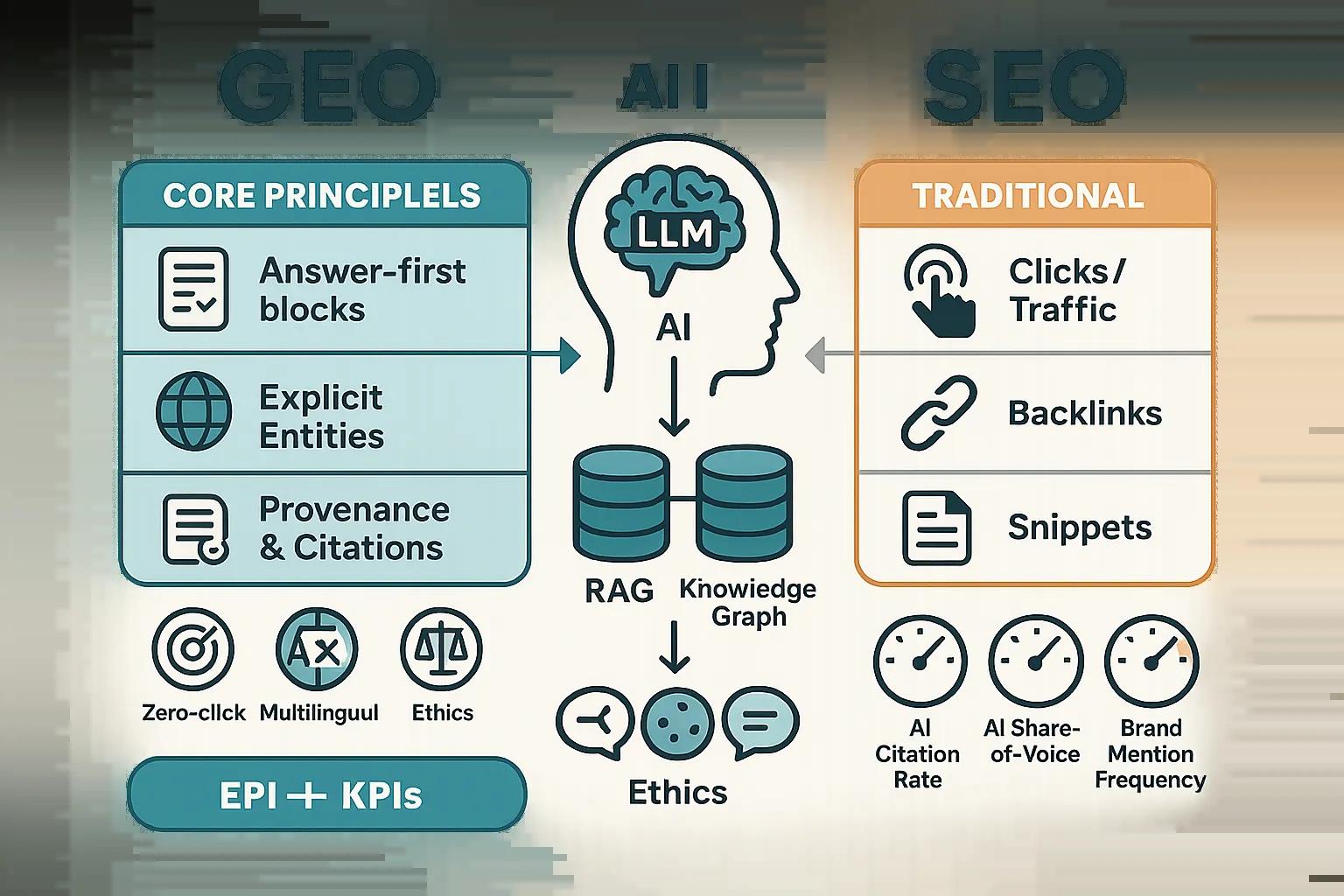
Generative Engine Optimization (GEO) is the practice of structuring content, entities, and provenance so retrieval systems and LLMs can find, interpret, and cite your material during answer synthesis, and GEO enhances visibility by aligning content with the exact inputs LLM pipelines use. The core GEO objective is to make your content semantically explicit: clear entities, concise answer-first passages, reliable citations, and structured metadata—each increases the probability of AI citation. GEO differs from traditional SEO by prioritizing citations and brand mentions over clicks, and by emphasizing machine-readable provenance and extractable answers that retrieval components can index. Those priorities guide different KPIs, content formats, and technical implementations that we explore next.
Content below highlights practical GEO tactics and their effects in a compact comparison to help you prioritize work that raises AI citation likelihood.
| GEO Tactic | What It Influences | Impact on LLM Visibility |
|---|---|---|
| Answer-First Snippets | Retrieval salience and extractability | High — short, explicit answers are more likely to be quoted |
| Structured Entities (About/Mentions) | Entity linking and knowledge graphs | High — clearer entity signals improve citation accuracy |
| Provenance & Citations | Trust and source selection by LLMs | Medium-High — explicit sourcing raises citation probability |
What Is Generative Engine Optimization and Its Key Principles?
Generative Engine Optimization is a set of content and metadata practices designed to make materials discoverable and citable by LLM-powered systems, and its principles center on clarity, structure, and trust. Key GEO principles include crafting concise, standalone answer paragraphs at the top of articles, marking entities explicitly with clear names and attributes, and ensuring provenance through citations and author metadata. GEO also emphasizes structured data—FAQ, HowTo, About properties—and consistent internal linking to reinforce entity relationships. These practices differ from classic SEO in that they create atomic, extractable units of truth that retrieval algorithms can directly ingest during RAG and answer-generation pipelines.
How Does GEO Shift Focus from Clicks to AI Citations and Brand Mentions?
GEO shifts the primary KPI from organic clicks toward AI citations, brand mentions in overviews, and share-of-voice within AI outputs, because LLMs surface information without requiring a site visit. AI citations are instances where an LLM quotes or references your content as a source, and brand mentions capture when an AI overview credits your organization within its synthesized answer. This shift affects attribution and revenue models: measurement must connect sampling of AI outputs to downstream conversions rather than relying solely on session-based analytics. Reorienting strategy toward citation rate, extraction quality, and branded answer frequency helps teams prioritize content that contributes to discoverability and long-term brand presence in AI-driven search.
What Content Strategies Improve Visibility in AI-Powered Search Results?
Answer-oriented, entity-rich content that demonstrates clear E-E-A-T signals increases the chance that LLMs will select and cite your material during synthesis, and these strategies focus on atomic answers, entity clarity, and proof points. Structuring content as small, self-contained answer blocks followed by supporting context makes it easier for retrieval algorithms to extract precise passages for RAG. Building topical depth around entities and maintaining authoritative citations improves the model’s confidence in sourcing your content. Below are tactical approaches that operational teams can implement to align content production with GEO principles.
These tactical approaches translate into practical steps publishers and content teams can adopt immediately.
- Provide an answer-first paragraph at the top of each page that directly answers the query in one to two sentences and then expand with detail.
- Mark entities explicitly in copy and via metadata so relationships (product → attribute, concept → definition) are machine-readable.
- Use short, authoritative microcontent (definitions, lists) that retrieval can extract without losing context.
How to Create Answer-Oriented and Entity-Rich Content for LLMs?
An effective pattern is a one-paragraph direct answer followed by depth: lead with the concise answer, then provide structured supporting evidence and entity context. Write the lead sentence so it can stand alone as a citation, then follow with 2–3 short paragraphs that explain mechanisms, examples, and related entities to give the model context for synthesis. Use definition lists, bolded entity names, and natural language "about" statements to surface entity relationships that can be mapped into knowledge graphs. Marking entities clearly and keeping answer blocks portable improves the chance that an LLM's retrieval step will return your text as a top candidate for citation.
Why Is E-E-A-T Critical for Building Trust and Authority in AI Search?
E-E-A-T — Experience, Expertise, Authoritativeness, Trustworthiness — functions as the human-equivalent signal set that helps LLM pipelines prefer reliable sources during answer composition, and explicit E-E-A-T markers raise citation likelihood. Demonstrable experience and expertise include linked author bios, transparent methodologies, and original research or data; authoritativeness comes from consistent topical depth and cross-references; trustworthiness uses verifiable citations and correction workflows. Presenting these signals inline—author credentials near bylines, methodological notes beneath claims, and clear sourcing—directly helps models assess provenance and improves the chance your content will be referenced in AI overviews.
Which Technical SEO Practices Support LLM Comprehension and AI Search Optimization?
Technical SEO for LLM comprehension emphasizes structured data, crawlable content, and retrieval-friendly indexing so that retrievers and RAG systems can access precise passages and entity metadata. Structured data types such as Article, FAQPage, HowTo, and About help machines link content to entities and attributes, while semantic internal linking and descriptive anchor text signal relationships across pages. Site health—fast responses, complete sitemaps, and canonical consistency—ensures retrieval systems index the best versions of content. The next paragraphs give specific implementation examples and validation checkpoints to improve machine comprehension and citation readiness.
Below is a concise implementation table listing key technical elements and concrete examples to help engineers and SEO teams prioritize work.
| Technical Element | Attribute | Implementation Example |
|---|---|---|
| Schema: Article/FAQ | Explicit Q&A and headline mapping | Add FAQPage with question/answer pairs and validated JSON-LD |
| About/Mentions properties | Entity linking to canonical identifiers | Use "about" with exact entity names and contextual descriptions |
| Sitemaps & Crawlable text | Retrieval accessibility | Ensure sitemap includes canonical URLs and noindex is avoided on primary pages |
How Does Structured Data and Schema Markup Improve AI Understanding?
Structured data supplies machine-readable semantics that mapping layers use to identify entities, attributes, and answer units, which increases the probability of accurate retrieval and citation. Implementing JSON-LD for Article, FAQPage, HowTo, and About sections provides clear signals about which text is an answer and which is background, helping retrievals prioritize concise, attributable passages. Validate schema with structured data testing tools and monitor coverage to ensure high-value pages expose these properties. Proper schema implementation also supports knowledge graph population and helps RAG systems match queries to the most relevant, authoritative sources.
What Role Do Internal Linking and Semantic Anchor Text Play in AI Visibility?
Internal linking organizes topic clusters into hub-and-spoke architectures that make entity relationships explicit, and semantic anchor text clarifies the exact attribute or entity relationship being linked. A topical hub page should link to supporting spokes with anchor text that pairs entity and attribute—e.g., "privacy policy data retention"—so retrieval systems can follow relationship signals during index-time processing. Shallow crawl depth for key topical hubs and consistent use of descriptive anchor phrases improve topical authority and help retrievers surface the best passages for RAG. Optimizing internal link patterns therefore directly supports entity clarity and contextual relevance for LLMs.
How Can Brands Measure and Monitor Their Influence in AI Search Environments?
Measuring AI influence requires new KPIs—AI citation rate, AI share-of-voice, and brand mention frequency in AI outputs—that capture visibility in synthesized answers rather than traditional click metrics. These metrics define how often LLMs use your content as a source, how much of the AI answer market your brand occupies, and how mentions trend over time. A monitoring cadence that combines automated sampling of AI outputs, manual query audits, and integration with analytics for downstream conversions creates a closed-loop process to link AI visibility to business outcomes. The following table defines these metrics and explains measurement approaches.
| Metric | Definition | How to Measure |
|---|---|---|
| AI Citation Rate | Percentage of sampled AI answers that cite your domain | Regular manual and API-driven LLM queries with citation extraction |
| AI Share-of-Voice | Proportion of AI overviews referencing your brand among competitors | Comparative sampling across target queries and competitor domains |
| Brand Mention Frequency | Count of unlinked brand mentions in AI outputs | Automated scraping of AI responses and natural language detection |
What Metrics Track AI Citation Rates and Brand Mentions Effectively?
AI Citation Rate is calculated by sampling relevant queries and recording how often the AI output cites your domain or quoting passages from it, while AI Share-of-Voice compares your citation frequency to competitors within the same query set. Sampling should be representative across intents and times of day, with weekly lightweight checks and quarterly deeper audits to capture trends. Dashboards can combine these counts with conversion events to estimate the impact of AI visibility on leads or sales, and baseline benchmarking establishes whether AI-driven presence is improving month over month. These measurement practices close the loop between visibility signals and business outcomes.
Which Tools and Processes Support Continuous AI Visibility Monitoring?
A robust monitoring stack blends manual LLM probing, automated API sampling, search console analytics, and specialized AI-visibility platforms to detect citations and mentions at scale. Weekly manual queries help validate model behavior and edge cases, while scheduled API sampling across models (when available) provides quantitative coverage; search console still captures traditional discovery and can be paired with conversion tracking to assess downstream impact. Establish responsibilities—content teams for query design, analytics teams for measurement, and engineering for automation—and set alerting thresholds for sudden citation drops or spikes. Combining human review with automated sampling creates a resilient monitoring process that surfaces both opportunities and regressions.
What Are the Future Trends and Challenges in Achieving LLM Visibility?
Future trends emphasize the rise of zero-click AI overviews, increased importance of provenance and transparency, and the need for multilingual entity strategies; these trends introduce both opportunity and risk. Zero-click answers will continue to change traffic patterns but offer alternative value: brand presence inside answers and driven conversions through attribution mechanisms. Ethical concerns—bias, misinformation, and poor attribution—require proactive sourcing, correction workflows, and clear provenance to maintain trust. Preparing for multilingual rollout and regulatory scrutiny will be critical for organizations that want durable presence across global LLM deployments.
Below are practical adaptation strategies teams should pursue to future-proof LLM visibility efforts.
- Maintain extractable, well-sourced answer blocks to increase citation probability.
- Implement robust provenance signals and correction processes to address misinformation.
- Prioritize multilingual entity mapping to support global LLM deployments and local relevance.
How Will Zero-Click Searches and AI Overviews Impact Website Traffic?
Zero-click AI overviews will likely reduce direct organic clicks for many informational queries, but they create new value by exposing brands inside answers where users often trust and act on provided information. The net traffic impact varies by vertical and intent; informational properties see larger declines in clicks but may gain branded recognition and downstream conversions through name recall. To adapt, publishers can optimize for micro-conversions (email signups, gated deep-dives) and design content that converts from summarized exposure rather than only from visits. Monetization approaches will increasingly combine direct conversions with brand-lift metrics tracked via AI citation and mention monitoring.
What Ethical Considerations and Multilingual Strategies Affect AI Search Optimization?
Ethical optimization requires transparent sourcing, bias mitigation, and a corrections workflow so that when an LLM surfaces incorrect or harmful content it can be traced and fixed; these practices increase trust and reduce reputational risk. Multilingual strategies demand prioritized entity parity—ensuring canonical entity pages exist in target languages and that translations preserve entity attributes and citations—so retrieval systems can match queries across locales. Regulatory trends will push for clearer attribution and content provenance, making early adoption of transparent schemas and correction processes both a trust-building and compliance-minded step. These measures preserve long-term visibility and protect brand integrity as AI search evolves.
About the Author
Adam Baetu is the founder of Funnel Automation and the creator of Nigel, an AI-powered system helping businesses improve visibility, trust, and discoverability across search engines and large language models. With over a decade of experience building automation, lead generation, and AI-driven growth systems for service-based businesses, Adam specialises in how AI evaluates authority, relevance, and credibility when recommending who to buy from.
Learn more about Nigel and AI-first visibility here:
Frequently Asked Questions
What are the key differences between Generative Engine Optimization (GEO) and traditional SEO?
Generative Engine Optimization (GEO) focuses on enhancing content visibility specifically for AI-driven search engines, prioritizing AI citations and brand mentions over traditional click metrics. Unlike traditional SEO, which emphasizes driving traffic through organic clicks, GEO aims to make content semantically explicit and easily retrievable by LLMs. This involves structuring content with clear entities, concise answer-first passages, and reliable citations, which are essential for being referenced in AI-generated responses. As a result, GEO shifts the measurement of success from clicks to how often content is cited by AI systems.
How can I ensure my content is optimized for multilingual LLMs?
To optimize content for multilingual Large Language Models (LLMs), it is crucial to create canonical entity pages in multiple languages while ensuring that translations maintain the integrity of entity attributes and citations. This involves using consistent terminology across languages and implementing structured data that supports multilingual entities. Additionally, consider localizing content to reflect cultural nuances and search behaviors in different regions. By prioritizing entity parity and clear provenance in various languages, you can enhance the discoverability and relevance of your content in global AI search environments.
What role does structured data play in improving AI search visibility?
Structured data plays a vital role in enhancing AI search visibility by providing machine-readable semantics that help LLMs identify entities, attributes, and answer units within your content. Implementing structured data types, such as Article, FAQPage, and HowTo, allows retrieval systems to prioritize concise, attributable passages during the answer synthesis process. This clear signaling improves the likelihood of your content being cited in AI-generated responses. Regular validation of structured data with testing tools ensures that high-value pages are correctly indexed, further supporting knowledge graph population and enhancing overall AI visibility.
How can brands effectively measure their AI citation rates?
Brands can measure their AI citation rates by regularly sampling relevant queries and tracking how often AI outputs cite their domain or quote passages from their content. This involves both manual and automated methods, such as API-driven queries that extract citation data. Establishing a consistent monitoring cadence—weekly for lightweight checks and quarterly for deeper audits—helps capture trends over time. By integrating these citation metrics with conversion tracking, brands can assess the impact of their AI visibility on business outcomes, allowing for data-driven adjustments to their content strategies.
What are the ethical considerations in AI search optimization?
Ethical considerations in AI search optimization include ensuring transparent sourcing, mitigating bias, and establishing correction workflows for inaccurate or harmful content. These practices are essential for maintaining trust and reducing reputational risks associated with AI-generated outputs. Additionally, organizations should prioritize clear attribution and provenance in their content to comply with emerging regulatory trends. By adopting ethical optimization strategies, brands can build credibility and protect their integrity as AI search technologies evolve, ultimately fostering a more responsible digital ecosystem.
How can I create content that is both answer-oriented and entity-rich?
To create content that is both answer-oriented and entity-rich, start with a concise, standalone answer at the beginning of your articles, followed by structured supporting evidence and context. Use clear entity names and attributes throughout the text, and incorporate definition lists or bolded terms to highlight key concepts. This approach not only makes it easier for LLMs to extract relevant information but also enhances the clarity and relevance of your content. By focusing on atomic answer blocks and maintaining authoritative citations, you increase the likelihood of being cited in AI-generated responses.
